Jesus did not say ‘I am the truth’, nor did he baptize with water… Water does not make you free; it is not the truth that sets free, because it is not information that brings you out of deception.
The business of baptism needs lies. It does not need to declare anyone innocent, but to declare everyone guilty of sin. It needs to make people believe that water cleans something more than the body.
But think: water does not remove ignorance. It can remove dirt or thirst, but it does not remove the ignorance that the manipulator needs in order to control you, obtain your money, and demand your obedience.
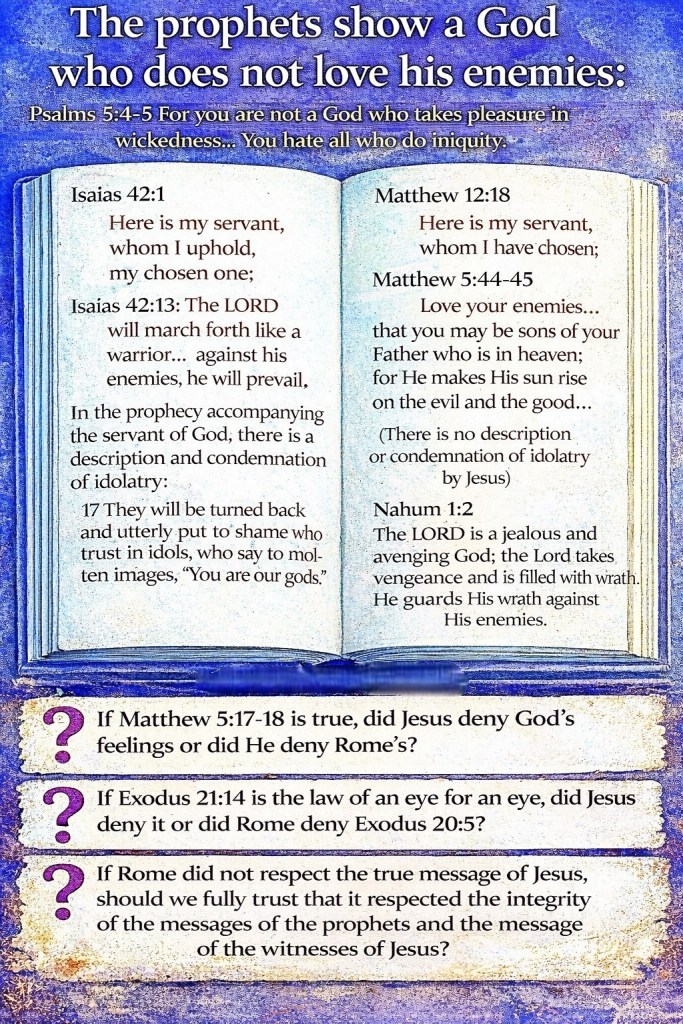
If Rome captured the message it once persecuted, why should we believe that it later respected it? Why assume that it transmitted it faithfully, honoring the truth and not its own interests of power?
Neither knowing a person nor getting wet with water removes the ignorance that causes the righteous to stumble into sin. False prophets lead people to commit sins through deception. The truth destroys those deceptions.
Jesus could not have said that he is the truth. First, because truth is information; it is a message. A man is not a message. A man is a creature who can transmit a message. If that message is true, then it is that message —not the man— that sets free.
Second, if Jesus had literally claimed that he is the truth, it would not be coherent but absurd. And God does not choose someone incoherent to be His servant. Freedom consists in not bowing the knee to anyone to render honor.
But the Roman Empire did not want free men. It wanted men on their knees: before its statues, before its representatives, before its system.
Even within the Bible —although it contains additions from the Empire— there are passages that show the logic of this:
In the Gospel of John 8:32: “And you shall know the truth, and the truth shall make you free.”
This is coherent: knowing the truth sets free. It does not say, “You will know a person and be free because that person is the truth.”
If freedom depended only on knowing an individual, then it would be enough to see him, without hearing anything, without understanding anything. That is absurd. Freedom comes from understanding the true message.
However, in the Gospel of John 14:6 it says: “I am the way, and the truth, and the life; no one comes to the Father except through me.”
That statement contradicts the previous principle. It does not point to understanding the truth, but to dependence on a figure. That fits more with a system of control than with a message of liberation.
So, what really sets people free from deception?
In Proverbs 11:9 it clearly says: “The hypocrite with his mouth destroys his neighbor, but through knowledge the righteous will be delivered.”
Wisdom sets free, not idolatry.
The righteous —not the gullible— are those who can recognize the coherence of truth. That is why in the Book of Daniel 12:1 it speaks of the liberation of a specific people: those who stand on the side of truth.
And later, in the Book of Daniel 12:10: “The wicked shall not understand, but the wise shall understand.”
The difference is not ritual; it is understanding.
Also, in the Gospel of John 17:17: “Sanctify them in your truth; your word is truth.”
Truth is the word, the message. Not a person. A man is not the word of God. He is, at most, a messenger.
This is made clear in the Book of Isaiah 6:8: “Whom shall I send?” And someone answers: “Here I am, send me.”
The one who is sent is not the message. He is the bearer of the message.
Contradictory minds do not understand. Coherent minds do.
Slander produces contradiction. And those who live by contradiction —the unjust— cannot recognize the truth. They do not love it, because they cannot tolerate it.
That is why, as the Book of Daniel 12:10 says, the wicked do not understand. Only those with understanding comprehend.
Ayudando al pensamiento crítico a sacudirse de dogmas impuestos desde la niñez. Soy creador del blog: https://ntiend.me (https://gabriels.work).
Este blog no solo está en español y tiene como propósito respetar la inteligencia frente al dogma.
Este blog no fue creado para defender la Biblia ni para buscarle una interpretación alternativa, porque eso sería darle crédito como un bloque coherente de mensajes. Los textos allí atribuidos a los santos contienen contradicciones demasiado numerosas para etiquetarlas como simples accidentes o diferencias de interpretación. Mientras se atribuye a los santos mensajes tanto de amor como de odio hacia sus enemigos, aquí hay gato encerrado. La cuestión no es cómo interpretar la Biblia o sus enigmas, sino saber hasta dónde llegan las raíces del engaño: si los mensajes están adulterados, no tiene sentido perder el tiempo intentando descifrar enigmas bíblicos posiblemente adulterados por la mano que mató a los santos y se apoderó de sus escritos para arrogarse la autoridad moral de determinar qué escritura, original o escrita por esa mano asesina, debía considerarse “la verdad” y cuál no.
//
Helping critical thinking shake off the dogmas imposed since childhood. I am the creator of the blog: https://ntiend.me (https://gabriels.work).
This blog is not only in Spanish and is intended to respect intelligence in the face of dogma.
This blog was not created to defend the Bible or to seek an alternative interpretation of it, because that would give it credit as a coherent body of messages. The texts attributed there to the saints contain far too many contradictions to dismiss them as mere accidents or differences in interpretation. While the saints are attributed with messages expressing both love and hatred toward their enemies, there is something fishy going on here. The question is not how to interpret the Bible or its enigmas, but rather how deep the roots of the deception go: if the messages have been adulterated, there is no point wasting time trying to decipher biblical enigmas possibly adulterated by the hand that killed the saints and seized their writings in order to arrogate to itself the moral authority to determine which writing, original or written by that murderous hand, was to be considered “the truth” and which was not.
Ver todas las entradas de José Carlos Galindo Hinostroza