The false prophet defends the ‘prosperity gospel’: ‘The only barren ground is your pocket when it refuses to release the seed’. What you’re about to discover will surprise you. The impostor dressed as a lamb speaks meekly, but his appetite betrays him when he sees meat. The true lamb withdraws when he sees meat and blood on the table; the wolf in sheep’s clothing draws near with desire, because his nature is to devour, not to graze.
Same god Zeus, same forbidden food—pork—and devil doctrines passed off as Jesus and his religion. //57
Jacob Deceived a Blind Man… And God Loved Him? //41
Walking on the edge of death along the dark path, but looking for the light, interpreting the lights projected on the mountains so as not to make a false step, to avoid death. //66
The prophecy of hell in the book of Isaiah, the Psalms, Proverbs, and the book of Enoch contain messages that make it clear that God does not love his enemies. Who put false messages in the mouth of Christ if not his enemies? //178
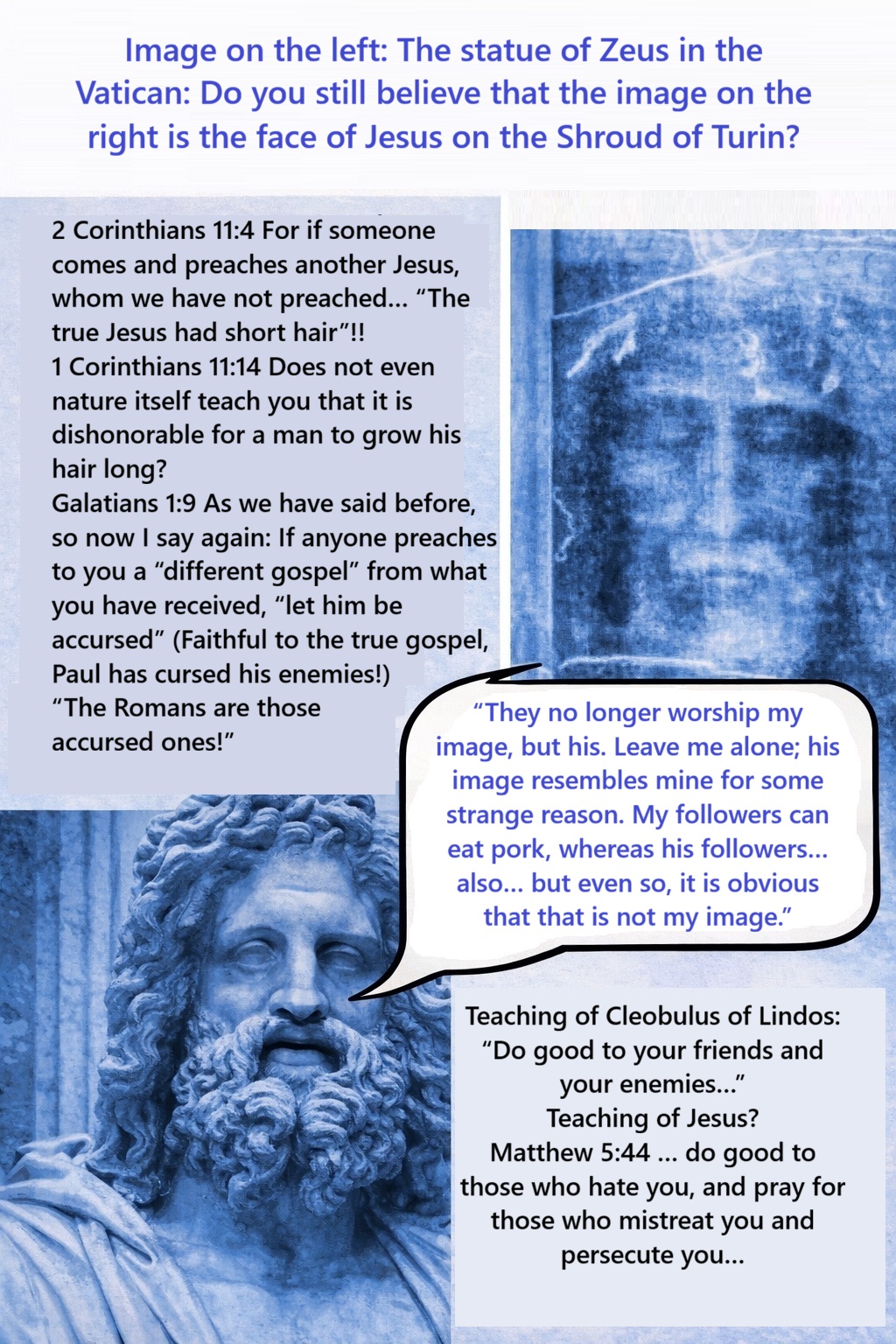
Jesus was not like Zeus, nor was love for the enemy His doctrine. Image on the left: the statue of Zeus in the Vatican. Do you still believe that the image on the right is the face of Jesus on the Shroud of Turin? 2 Corinthians 11:4: ‘For if someone comes and preaches another Jesus, whom we have not preached…’ ‘The true Jesus had short hair!!’ 1 Corinthians 11:14: ‘Does not even nature itself teach you that it is dishonorable for a man to have long hair?’ Galatians 1:9: ‘As we have said before, so now I say again: if anyone preaches to you a different gospel from what you have received, let him be accursed’ (faithful to the true gospel, Paul has cursed his enemies!). ‘The Romans are those accursed ones!’ Zeus says: ‘They no longer worship my image, but his. Leave me alone; his image resembles mine for some strange reason. My followers can eat pork; his followers… can also… yet even so, it is obvious that this is not my image.’ Teaching of Cleobulus of Lindos: ‘Do good to your friends and enemies…’ Teaching of Jesus? Matthew 5:44: ‘…do good to those who hate you, and pray for those who mistreat you and persecute you…’. //61
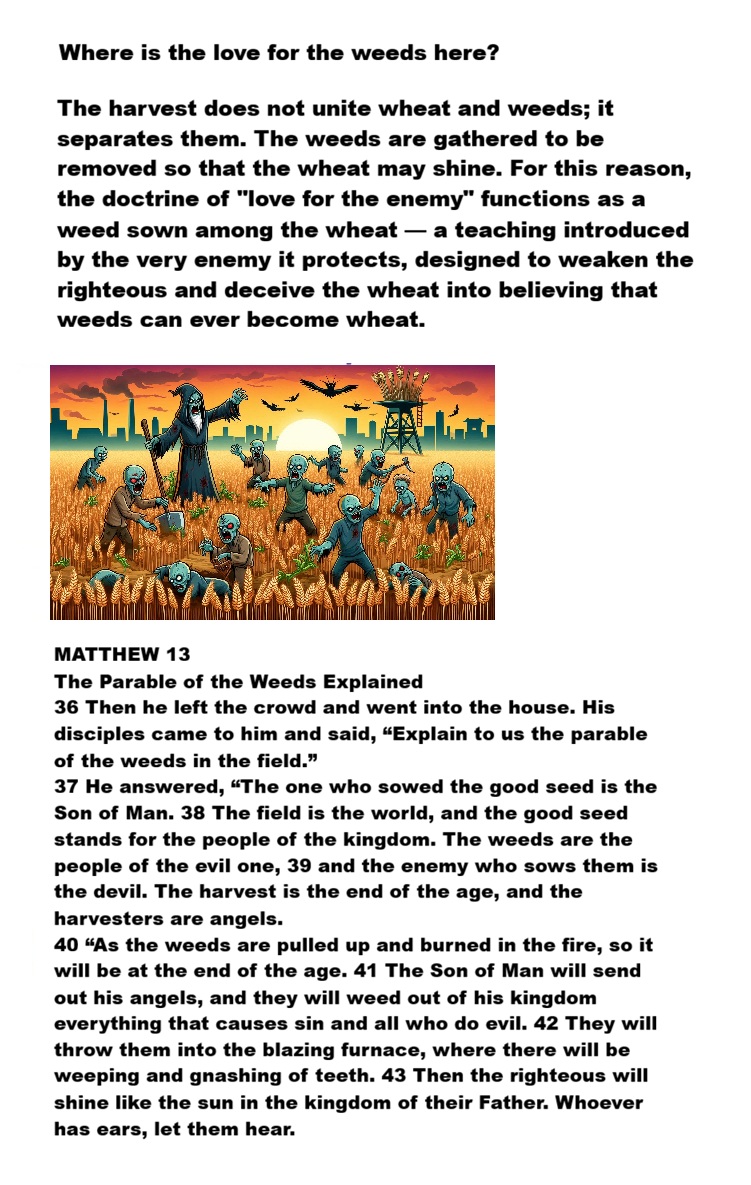
Where is the love for the weeds here? The harvest does not unite the wheat and the weeds; it separates them. The weeds are gathered to be removed so that the wheat may shine. For this reason, the doctrine of ‘love for the enemy’ functions like weeds sown among the wheat, a teaching introduced by the very enemy it protects, designed to weaken the righteous and deceive the wheat into believing that the weeds can one day become wheat. MATTHEW 13 The Parable of the Weeds Explained. 36 Then He left the crowd and went into the house. His disciples came to Him and said: ‘Explain to us the parable of the weeds in the field.’ 37 He answered: ‘The one who sows the good seed is the Son of Man. 38 The field is the world, and the good seed represents the children of the kingdom. The weeds are the children of the evil one, 39 and the enemy who sows them is the devil. The harvest is the end of the age, and the reapers are the angels. 40 As the weeds are pulled up and burned in the fire, so it will be at the end of the age. 41 The Son of Man will send His angels, and they will remove from His kingdom everything that causes sin and all who do evil. 42 And they will throw them into the furnace of fire; there will be weeping and gnashing of teeth. 43 Then the righteous will shine like the sun in the kingdom of their Father. He who has ears, let him hear.’ //144
Ayudando al pensamiento crítico a sacudirse de dogmas impuestos desde la niñez. Soy creador del blog: https://ntiend.me (https://gabriels.work).
Este blog no solo está en español y tiene como propósito respetar la inteligencia frente al dogma.
Este blog no fue creado para defender la Biblia ni para buscarle una interpretación alternativa, porque eso sería darle crédito como un bloque coherente de mensajes. Los textos allí atribuidos a los santos contienen contradicciones demasiado numerosas para etiquetarlas como simples accidentes o diferencias de interpretación. Mientras se atribuye a los santos mensajes tanto de amor como de odio hacia sus enemigos, aquí hay gato encerrado. La cuestión no es cómo interpretar la Biblia o sus enigmas, sino saber hasta dónde llegan las raíces del engaño: si los mensajes están adulterados, no tiene sentido perder el tiempo intentando descifrar enigmas bíblicos posiblemente adulterados por la mano que mató a los santos y se apoderó de sus escritos para arrogarse la autoridad moral de determinar qué escritura, original o escrita por esa mano asesina, debía considerarse “la verdad” y cuál no.
//
Helping critical thinking shake off the dogmas imposed since childhood. I am the creator of the blog: https://ntiend.me (https://gabriels.work).
This blog is not only in Spanish and is intended to respect intelligence in the face of dogma.
This blog was not created to defend the Bible or to seek an alternative interpretation of it, because that would give it credit as a coherent body of messages. The texts attributed there to the saints contain far too many contradictions to dismiss them as mere accidents or differences in interpretation. While the saints are attributed with messages expressing both love and hatred toward their enemies, there is something fishy going on here. The question is not how to interpret the Bible or its enigmas, but rather how deep the roots of the deception go: if the messages have been adulterated, there is no point wasting time trying to decipher biblical enigmas possibly adulterated by the hand that killed the saints and seized their writings in order to arrogate to itself the moral authority to determine which writing, original or written by that murderous hand, was to be considered “the truth” and which was not.
Ver todas las entradas de José Carlos Galindo Hinostroza