The story of Jesus’ resurrection does not match the prophecies.
The resurrection of Jesus: a lie of the Roman Empire.
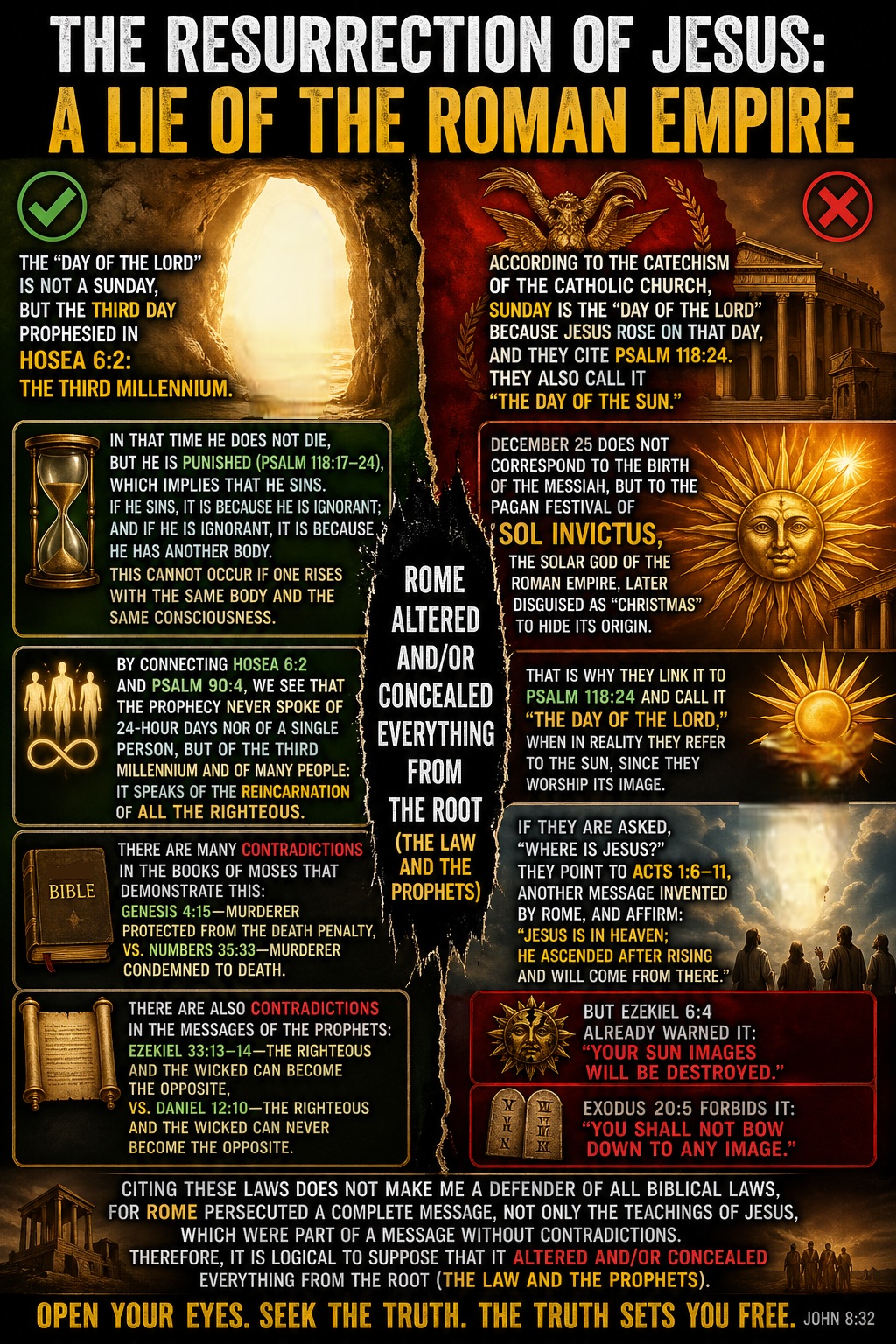
According to the Catechism of the Catholic Church, Sunday is the «day of the Lord» because Jesus rose on that day, and they cite Psalm 118:24 as justification. They also call it «the day of the sun.»
However, according to Matthew 21:33–44, the return of Jesus is related to Psalm 118, which makes no sense if he already rose.
The «day of the Lord» is not a Sunday, but the third day prophesied in Hosea 6:2: the third millennium.
In that time he does not die, but he is punished (Psalm 118:17–24), which implies that he sins. If he sins, it is because he is ignorant; and if he is ignorant, it is because he has another body. This cannot occur if one rises with the same body and the same consciousness.
By connecting Hosea 6:2 and Psalm 90:4, we see that the prophecy never spoke of 24-hour days nor of a single person, but of the third millennium and of many people: it speaks of the reincarnation of all the righteous.
December 25 does not correspond to the birth of the Messiah, but to the pagan festival of Sol Invictus, the solar god of the Roman Empire, later disguised as «Christmas» to hide its origin.
That is why they link it to Psalm 118:24 and call it «the day of the Lord,» when in reality they refer to the sun, since they worship its image.
If they are asked, «Where is Jesus?» they point to Acts 1:6–11, another message invented by Rome, and affirm: «Jesus is in heaven; he ascended after rising and will come from there.»
But Ezekiel 6:4 already warned it: «Your sun images will be destroyed.»
Exodus 20:5 forbids it: «You shall not bow down to any image.»
Citing these laws does not make me a defender of all biblical laws, for Rome persecuted a complete message, not only the teachings of Jesus, which were part of a message without contradictions.
Therefore, it is logical to suppose that it altered and/or concealed everything from the root (the Law and the Prophets).
There are many contradictions in the books of Moses that demonstrate this: Genesis 4:15—murderer protected from the death penalty, vs. Numbers 35:33—murderer condemned to death.
There are also contradictions in the messages of the prophets: Ezekiel 33:13–14—the righteous and the wicked can become the opposite, vs. Daniel 12:10—the righteous and the wicked can never become the opposite.
The story of Jesus’ resurrection does not match the prophecies.
Ayudando al pensamiento crítico a sacudirse de dogmas impuestos desde la niñez. Soy creador del blog: https://ntiend.me (https://gabriels.work).
Este blog no solo está en español y tiene como propósito respetar la inteligencia frente al dogma.
Este blog no fue creado para defender la Biblia ni para buscarle una interpretación alternativa, porque eso sería darle crédito como un bloque coherente de mensajes. Los textos allí atribuidos a los santos contienen contradicciones demasiado numerosas para etiquetarlas como simples accidentes o diferencias de interpretación. Mientras se atribuye a los santos mensajes tanto de amor como de odio hacia sus enemigos, aquí hay gato encerrado. La cuestión no es cómo interpretar la Biblia o sus enigmas, sino saber hasta dónde llegan las raíces del engaño: si los mensajes están adulterados, no tiene sentido perder el tiempo intentando descifrar enigmas bíblicos posiblemente adulterados por la mano que mató a los santos y se apoderó de sus escritos para arrogarse la autoridad moral de determinar qué escritura, original o escrita por esa mano asesina, debía considerarse “la verdad” y cuál no.
//
Helping critical thinking shake off the dogmas imposed since childhood. I am the creator of the blog: https://ntiend.me (https://gabriels.work).
This blog is not only in Spanish and is intended to respect intelligence in the face of dogma.
This blog was not created to defend the Bible or to seek an alternative interpretation of it, because that would give it credit as a coherent body of messages. The texts attributed there to the saints contain far too many contradictions to dismiss them as mere accidents or differences in interpretation. While the saints are attributed with messages expressing both love and hatred toward their enemies, there is something fishy going on here. The question is not how to interpret the Bible or its enigmas, but rather how deep the roots of the deception go: if the messages have been adulterated, there is no point wasting time trying to decipher biblical enigmas possibly adulterated by the hand that killed the saints and seized their writings in order to arrogate to itself the moral authority to determine which writing, original or written by that murderous hand, was to be considered “the truth” and which was not.
Ver todas las entradas de José Carlos Galindo Hinostroza