The false prophet absolves you of every sin, except the sin of thinking for yourself. The blood shed in the name of the homeland often only nourishes the power of traitors. It depends on how you see it.
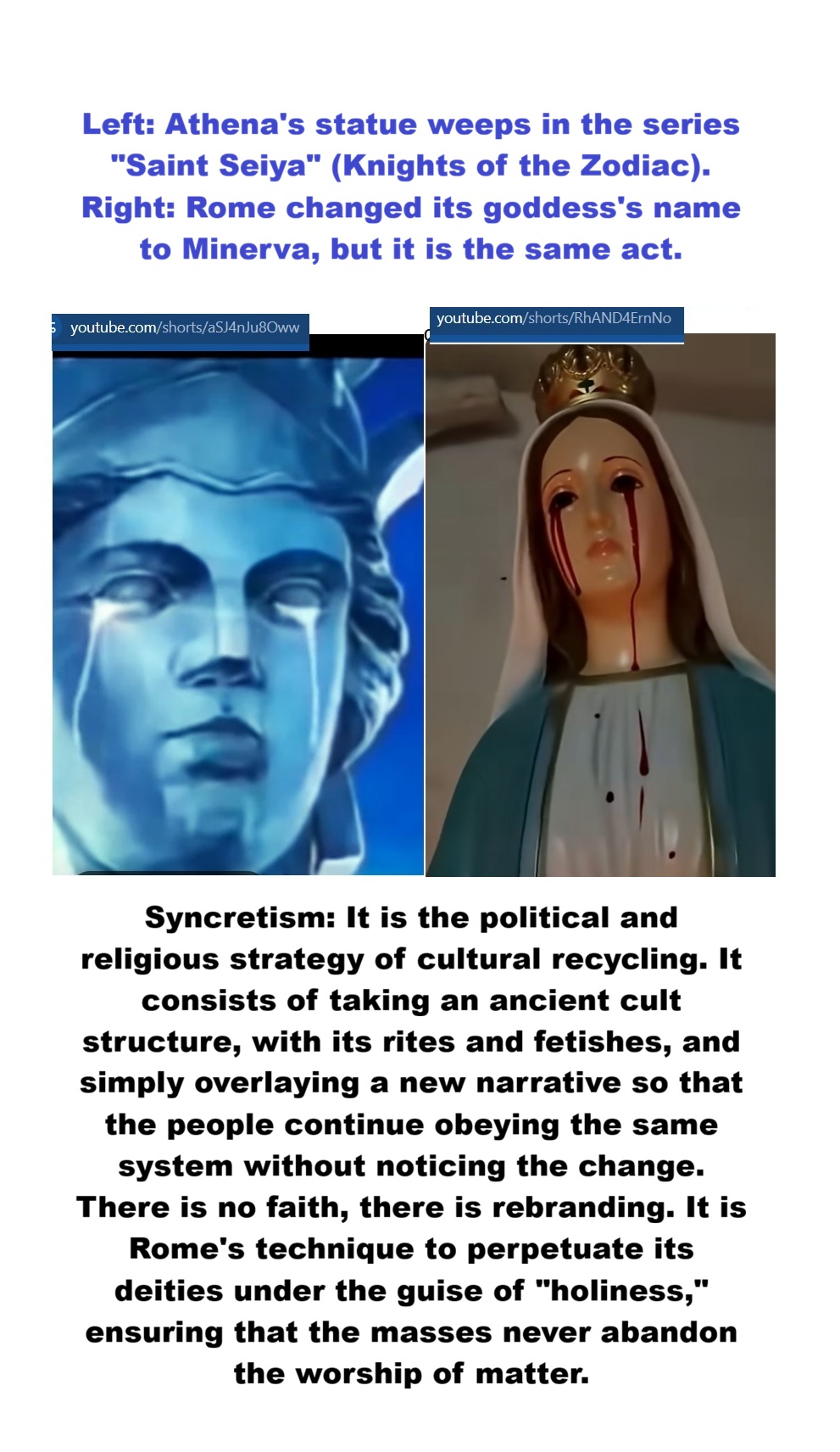
Left: The statue of Athena cries in the series ‘Saint Seiya’ (Knights of the Zodiac). Right: Rome changed the name of its goddess to Minerva, but it is the same act. https : // youtube . com / shorts / aSJ4nJu8Oww https : // youtube . com / shorts / RhAND4ErnNo Syncretism: It is the political and religious strategy of cultural recycling. It consists of taking an old structure of worship, with its rites and fetishes, and simply overlaying a new narrative so that people continue obeying the same system without noticing the change. There is no faith, there is a rebranding. It is Rome’s technique to perpetuate its deities under the disguise of ‘holiness’, ensuring that the masses never abandon the worship of matter. //130
If Proverbs 29:27 and Proverbs 17:15 say that the righteous hate the wicked and that God detests anyone who condemns the righteous or justifies the wicked, then it is absurd to maintain that the author of 1 Peter 3:18—who claims that the righteous gave his life for the unrighteous—was truly Peter, and not Rome, which killed him. This is not about when Rome converted to Christianity, but about how it turned into Christianity the religion that bothered it, so that it would stop bothering it and it could begin to impose it on its neighbors and its colonies, in which colonies of fleas emerge from puppet governments that are like the flea-ridden dogs of the filthy usurper Roman god. When drivers and other workers are murdered by extortionists, the fleas suck the blood of the productive fabric of society. Many workers have been deprived of their lives. However, the judicial system does not take the lives of the parasites; on the contrary, it shelters them so that they can siphon off the taxes of those who do work and do not parasitize like these fleas. Here are the traces of the deception: 1 Peter 3:18 says that a righteous one gave his life for the unrighteous; Matthew 5:44 says that the righteous Jesus commanded to love enemies; but Proverbs 29:27 and Proverbs 17:15 say that the righteous hate the unrighteous and that God abhors those who justify the wicked. Therefore, it is impossible that Jesus gave his life for the unrighteous in order to justify them. Furthermore, Revelation 6:9–10 shows the saints crying out for vengeance for their deaths; therefore, an eye for an eye was his message. //78
Ayudando al pensamiento crítico a sacudirse de dogmas impuestos desde la niñez. Soy creador del blog: https://ntiend.me (https://gabriels.work).
Este blog no solo está en español y tiene como propósito respetar la inteligencia frente al dogma.
Este blog no fue creado para defender la Biblia ni para buscarle una interpretación alternativa, porque eso sería darle crédito como un bloque coherente de mensajes. Los textos allí atribuidos a los santos contienen contradicciones demasiado numerosas para etiquetarlas como simples accidentes o diferencias de interpretación. Mientras se atribuye a los santos mensajes tanto de amor como de odio hacia sus enemigos, aquí hay gato encerrado. La cuestión no es cómo interpretar la Biblia o sus enigmas, sino saber hasta dónde llegan las raíces del engaño: si los mensajes están adulterados, no tiene sentido perder el tiempo intentando descifrar enigmas bíblicos posiblemente adulterados por la mano que mató a los santos y se apoderó de sus escritos para arrogarse la autoridad moral de determinar qué escritura, original o escrita por esa mano asesina, debía considerarse “la verdad” y cuál no.
//
Helping critical thinking shake off the dogmas imposed since childhood. I am the creator of the blog: https://ntiend.me (https://gabriels.work).
This blog is not only in Spanish and is intended to respect intelligence in the face of dogma.
This blog was not created to defend the Bible or to seek an alternative interpretation of it, because that would give it credit as a coherent body of messages. The texts attributed there to the saints contain far too many contradictions to dismiss them as mere accidents or differences in interpretation. While the saints are attributed with messages expressing both love and hatred toward their enemies, there is something fishy going on here. The question is not how to interpret the Bible or its enigmas, but rather how deep the roots of the deception go: if the messages have been adulterated, there is no point wasting time trying to decipher biblical enigmas possibly adulterated by the hand that killed the saints and seized their writings in order to arrogate to itself the moral authority to determine which writing, original or written by that murderous hand, was to be considered “the truth” and which was not.
Ver todas las entradas de José Carlos Galindo Hinostroza