Jacob Deceived a Blind Man… And God Loved Him? (Video language:English) /413/ https://youtu.be/3m7YKmmPL44,
Day 196
Brave Words Against Mandatory Military Service: Who Are the Enemies of Civilians? (Video language:Spanish) /420/ https://youtu.be/bvZyU0qCiK8
«The Parable of the Unjust Steward as a Warning About the Unfaithful Who Would Corrupt the Message.
In the parable of the unjust steward, an administrator is caught mismanaging his master’s goods, and the master tells him: ‘You can no longer be steward.’ Then the man thinks about his future and decides to alter the debts of the debtors in order to gain their favor and secure a place to live (Luke 16:1–8).
But… what if the parable concealed a deeper message? Jesus constantly spoke against the unfaithful and the corrupt.
Then an unsettling question arises: did Jesus know that, afterward, unfaithful men would alter the original message, just as the steward altered his master’s accounts?
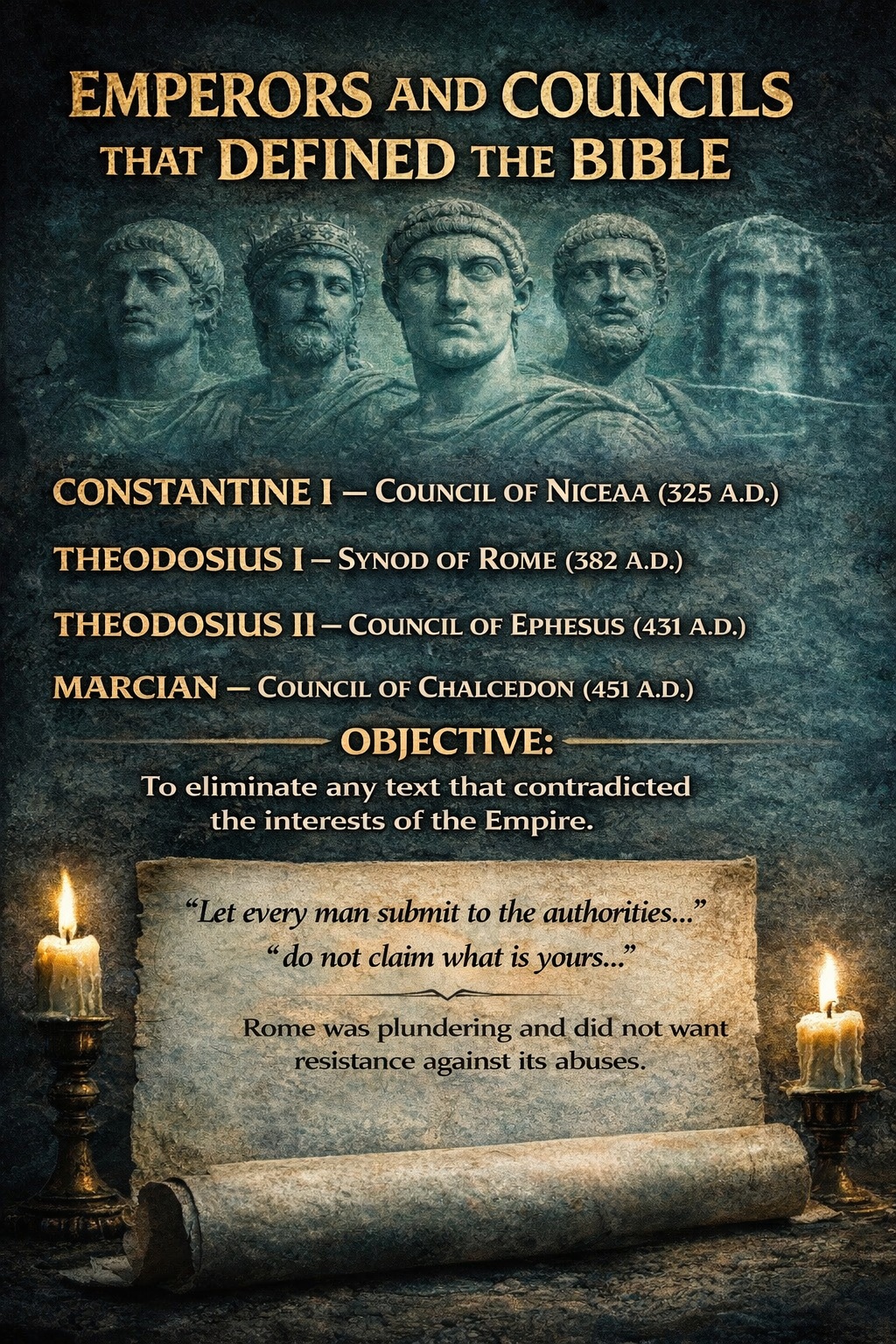
What if the Roman councils were the reflection of that parable? What if part of what was later presented as truth about Jesus was, in reality, a modified version of his original teaching?
Because something never completely fit together.
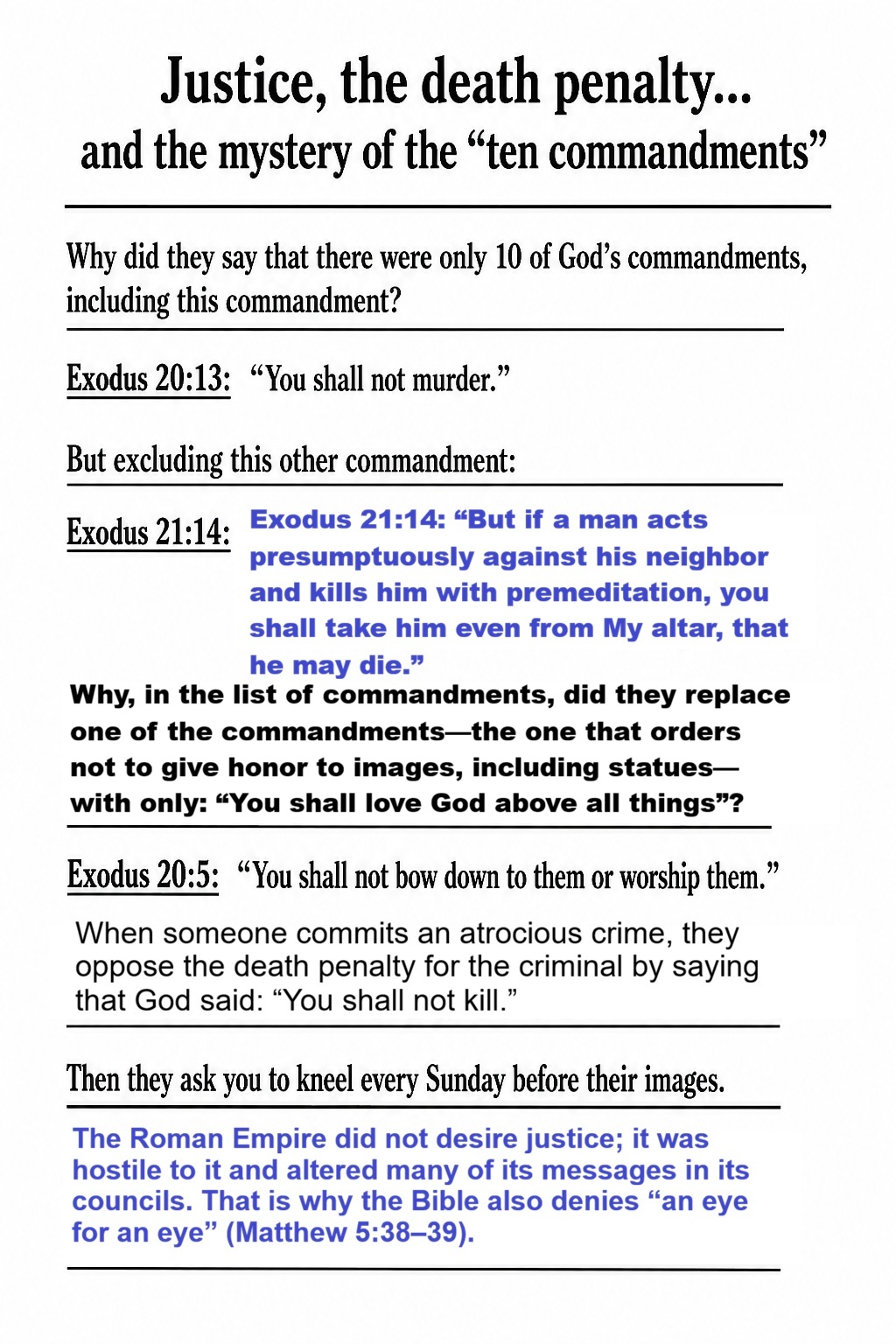
On one hand: ‘Blessed are those who hunger and thirst for justice’ (Matthew 5:6).
On the other hand: ‘An eye for an eye and a tooth for a tooth’ (Exodus 21:24, Leviticus 24:20, Deuteronomy 19:21).
And also: ‘Do not resist the evil person’ and ‘love your enemies’ (Matthew 5:39–44).
Furthermore: ‘Do not think that I have come to abolish the law… but to fulfill it’ (Matthew 5:17–18).
Can you imagine that a message saying this could be coherent?: ‘Blessed are those who hunger and thirst for justice… as long as they forget about an eye for an eye and love the enemy of justice.’
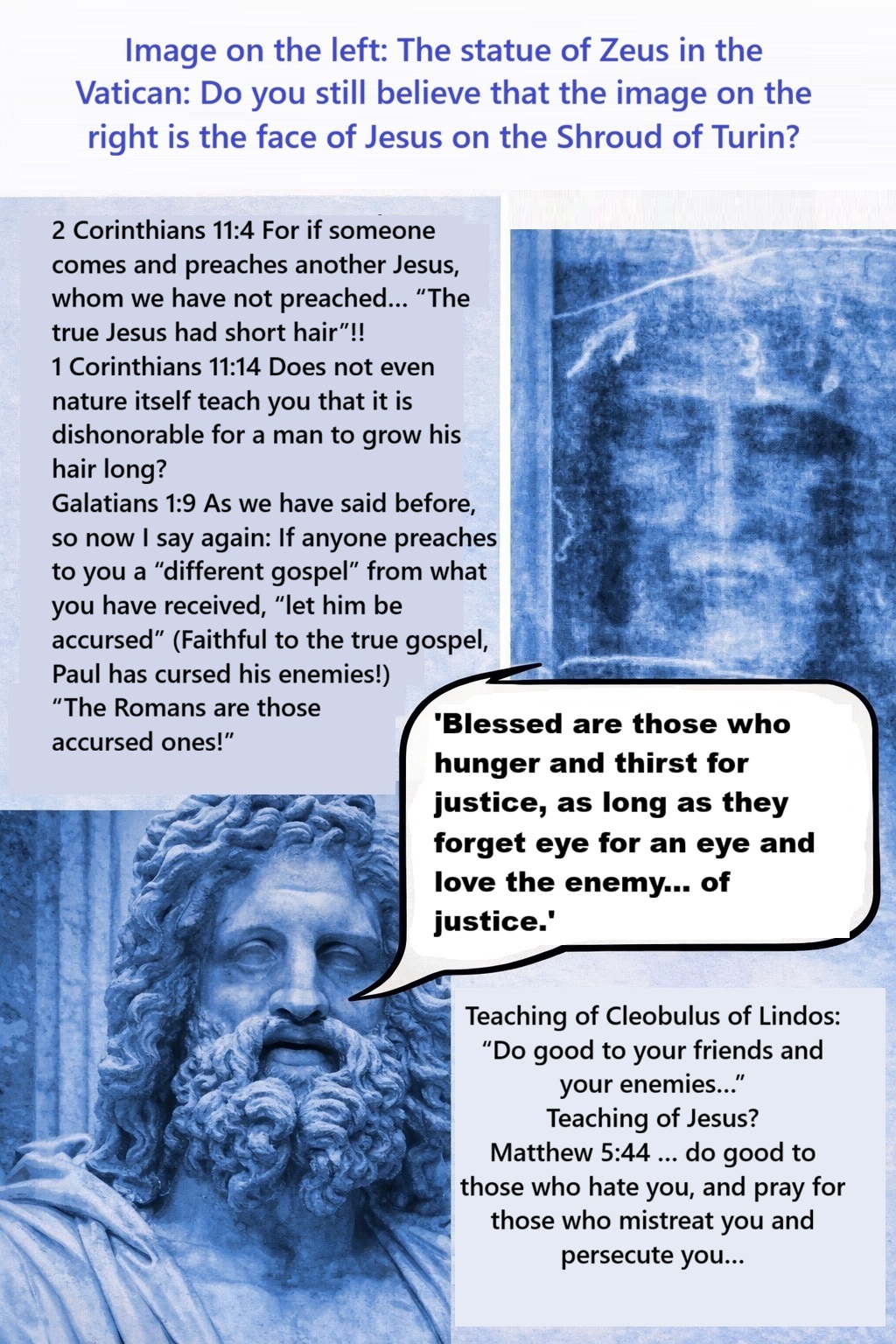
Did Jesus warn, through the parable of the unjust steward, that persecuting Rome would alter his message after finding itself condemned by it?
«
«In Mark 3:29, the ‘sin against the Holy Spirit’ is warned as unforgivable. However, history and the practices of Rome reveal a shocking moral inversion: the truly unforgivable sin, according to their dogma, is questioning the credibility of their Bible. Meanwhile, serious crimes such as the killing of innocents have been ignored or justified under the same authority that claimed to be infallible. This post examines how this ‘unique sin’ was constructed and how the institution used it to protect its power while justifying historical injustices.
In purposes contrary to Christ is the Antichrist, if you read Isaiah 11 you will see the mission of Christ in his second life, and it is not to favor everyone but only the righteous, but the Antichrist is inclusive, despite being unjust, he wants to climb onto Noah’s Ark, despite being unjust he wants to leave Sodom with Lot… Happy are those to whom these words are not offensive. He who is not offended by this message, that one is righteous, congratulations to him: Christianity was created by the Romans, only a mind friendly to celibacy, proper of Greek and Roman leaders, enemies of the ancient Jews, could conceive a message like the one that says: ‘These are the ones who did not defile themselves with women, for they remained virgins. They follow the Lamb wherever he goes. They were purchased from among mankind and offered as firstfruits to God and to the Lamb’ in Revelation 14:4, or a message like this one which is similar: ‘For in the resurrection they neither marry nor are given in marriage, but are like the angels of God in heaven,’ in Matthew 22:30, both messages sound as if they came from a Roman Catholic priest, and not from a prophet of God who seeks this blessing for himself: He who finds a wife finds what is good and receives favor from the Lord (Proverbs 18:22), Leviticus 21:14 A widow, or a divorced woman, or a woman who has been defiled, or a prostitute, he shall not marry; but he shall take as a wife a virgin from his own people.
I am not Christian; I am henotheist. I believe in one supreme God above all, and I believe that several created gods exist—some faithful, others deceivers. I only pray to the supreme God. But since I was indoctrinated from childhood in Roman Christianity, I believed in its teachings for many years. I applied those ideas even when common sense told me otherwise. For example—so to speak—I turned the other cheek to a woman who had already struck me on one. A woman who, at first, acted like a friend, but then, without justification, began treating me as if I were her enemy, with strange and contradictory behavior. Influenced by the Bible, I believed she had become an enemy because of some spell, and that what she needed was prayer to return to being the friend she had once shown herself to be (or pretended to be). But in the end, everything only got worse. As soon as I had the chance to dig deeper, I uncovered the lie and felt betrayed in my faith. I came to understand that many of those teachings did not come from the true message of justice, but from Roman Hellenism infiltrated into the Scriptures. And I confirmed I had been deceived. That’s why I now denounce Rome and its fraud. I do not fight against God, but against the slanders that have corrupted His message. Proverbs 29:27 declares that the righteous hates the wicked. However, 1 Peter 3:18 claims that the righteous died for the wicked. Who can believe that someone would die for those he hates? To believe it is to have blind faith; it is to accept incoherence. And when blind faith is preached, could it be because the wolf wants his prey not to see the deception?
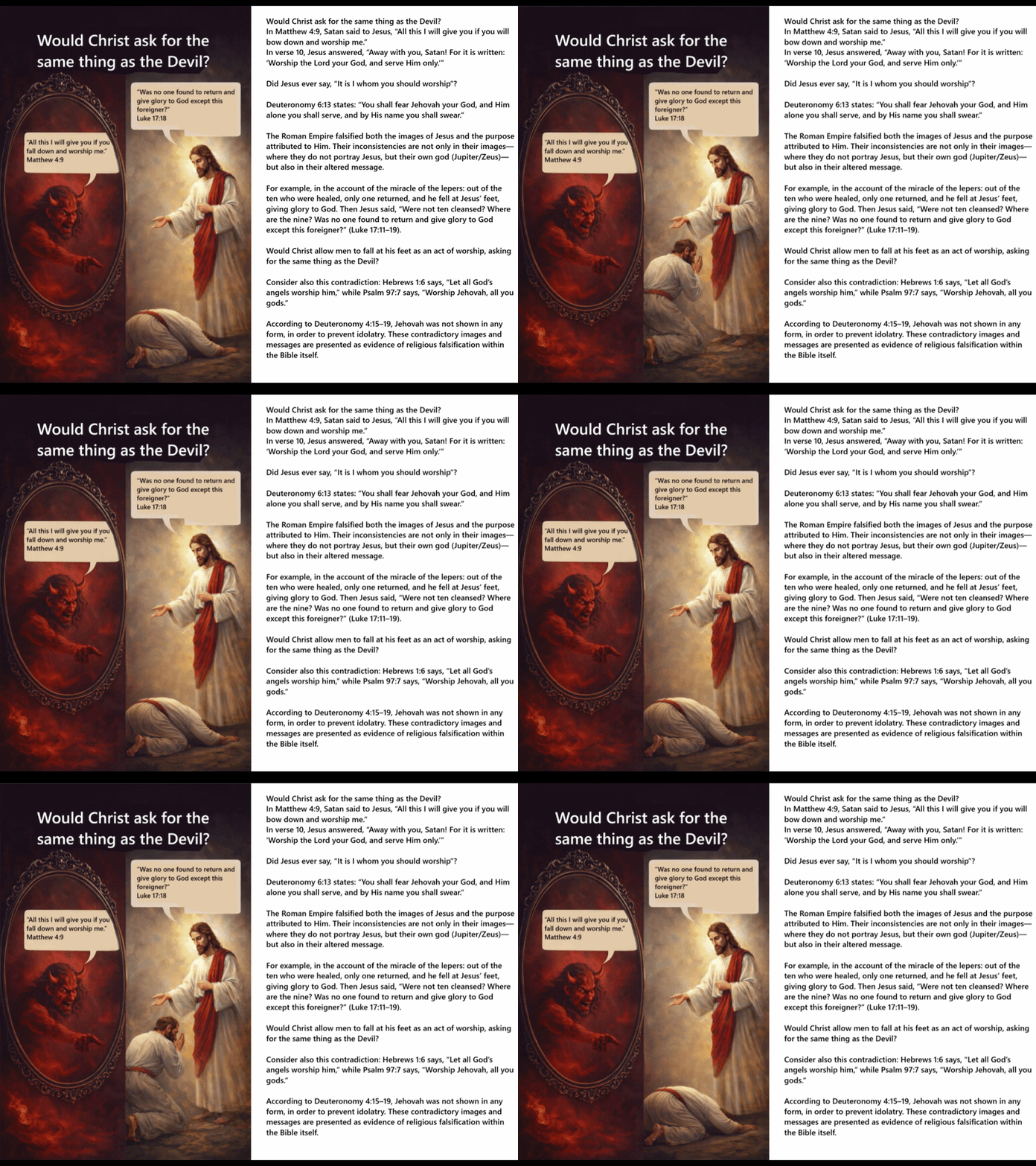
Jehovah will shout like a mighty warrior: ‘I will take vengeance on My enemies!’
(Revelation 15:3 + Isaiah 42:13 + Deuteronomy 32:41 + Nahum 1:2–7)
And what about the so-called ‘love for the enemy’ that, according to some Bible verses, the Son of Jehovah supposedly preached—claiming we should imitate His Father’s perfection through universal love? (Mark 12:25–37, Psalm 110:1–6, Matthew 5:38–48)
That is a lie spread by the enemies of both Father and Son.
A false doctrine born from mixing Hellenism with sacred words.»
1 Sự thức tỉnh của Chile: Sự sụp đổ của các giáo điều Giáo hội và sự giải phóng nhận thức https://144k.xyz/2026/09/18/su-thuc-tinh-cua-chile-su-sup-do-cua-cac-giao-dieu-giao-hoi-va-su-giai-phong-nhan-thuc/ 2 Получают ли ложные нищие и лжепророки выгоду от ложных учений? https://gabriels.work/2026/07/23/idi09fpfb/ 3 Планетата, погълната от двете си луни https://antibestia.com/2026/06/30/idi53moons/ 4 不义管家的比喻:关于那些将篡改信息之不忠者的警告。 https://144k.xyz/2026/05/25/idi44a/ 5 «Yo prefiero abrazarme con ella, y no con la muerte.» https://depuracion-del-mensaje.blogspot.com/2026/07/yo-prefiero-abrazarme-con-ella-y-no-con.html
«Has Isaiah’s Prophecy About the Desolate Cities Already Been Fulfilled?
According to the Bible, Isaiah says that some people will not see:
Isaiah 6:10:
‘Make the heart of this people dull, and make their ears heavy, and blind their eyes, lest they see with their eyes, and hear with their ears, and understand with their heart, and be converted, and be healed.’
Isaiah 6:11-12:
Then I said, ‘How long, Lord?’ And He answered, ‘Until the cities lie waste without inhabitant, and the houses are without people, and the land becomes utterly desolate; until the LORD has removed men far away, and the abandoned places are multiplied in the midst of the land.’
And regarding other people, Isaiah says that they must see:
Isaiah 42:6-7:
‘I, the LORD, have called you in righteousness, and will hold your hand; I will keep you and give you as a covenant to the people, as a light to the nations, to open the eyes of the blind, to bring the prisoners out of the prison, and those who dwell in darkness out of the prison house.’
The Bible also says that Jesus came to bring judgment:
John 9:39:
‘And Jesus said, ‘For judgment I have come into this world, so that those who do not see may see, and those who see may become blind.»
The contradiction presented:
If Jesus had come to fulfill the prophecies of the final judgment, then the final judgment would already have brought justice through His judgment, yet we see that justice does not prevail. Therefore, that prophecy was not fulfilled through Him, because for it to be fulfilled in someone, that person must see justice triumph:
Isaiah 42:1-4:
‘Behold My servant, whom I uphold; My chosen one, in whom My soul delights. I have put My Spirit upon Him; He will bring justice to the nations.
He will not cry out, nor raise His voice, nor cause it to be heard in the streets.
A bruised reed He will not break, and a smoldering wick He will not extinguish; He will faithfully bring forth justice.
He will not fail nor be discouraged until He has established justice on the earth; and the coastlands shall wait for His law.’
However, the Bible presents Jesus as fulfilling that prophecy:
Matthew 12:16-21:
‘And He strictly warned them not to make Him known, so that what was spoken through the prophet Isaiah might be fulfilled:
‘Behold My Servant, whom I have chosen; My Beloved, in whom My soul is well pleased. I will put My Spirit upon Him, and He shall proclaim judgment to the Gentiles.
He will not quarrel, nor cry out, nor will anyone hear His voice in the streets.
A bruised reed He will not break, and a smoldering wick He will not extinguish, until He leads judgment to victory.
And in His name the Gentiles will hope.»
Here another inconsistency arises, not only because justice does not reign on the earth, but also because the Bible repeatedly shows Jesus speaking loudly and raising His voice before crowds, as in the Sermon on the Mount:
Matthew 5:1-2:
‘And seeing the multitudes, He went up on a mountain; and after He sat down, His disciples came to Him. Then He opened His mouth and taught them, saying…’
Consider this paradox:
Matthew 5:6:
‘Blessed are those who hunger and thirst for justice, for they shall be satisfied.’
In Matthew 5:6 He blesses those who hunger and thirst for justice—that is, the righteous. But further down we read:
Matthew 5:38-39:
‘You have heard that it was said, ‘An eye for an eye and a tooth for a tooth.’ But I tell you, do not resist an evil person. Instead, if anyone slaps you on the right cheek, turn to him the other also.’
Is hungering and thirsting for justice the same as wanting to receive more attacks from an evil aggressor?
Matthew 5:17 says that He came to fulfill the Law, yet the Law commands that ‘eye for eye,’ which the very same passage alters:
Matthew 5:17:
‘Do not think that I have come to abolish the Law or the Prophets; I have not come to abolish them but to fulfill them.’
Matthew 5 portrays Him as fulfilling the Law that commands the removal of evil, while at the same time portraying Him as instructing people not to resist evil:
Deuteronomy 19:19-21:
‘Then you shall do to him as he intended to do to his brother; so you shall remove the evil from among you. And those who remain shall hear and fear, and shall never again commit any such evil among you. Your eye shall not pity: life for life, eye for eye, tooth for tooth, hand for hand, foot for foot.’
It can be concluded that the Roman institutional structure did not preserve the original message intact, but instead intervened in the texts. That alteration is not limited only to the words attributed to Jesus, but also extends to the traditions of the scribes and to the prophets of the Old Testament.
This is not about placing the Old Testament above the New Testament, but about pointing out the evident fractures throughout the entire body of the book.
A brief piece of evidence of these internal contradictions:
On the one hand, the covenant’s command requires performing ritual cuts on one’s own body:
Genesis 17:10–11:
‘This is My covenant, which you shall keep, between Me and you and your descendants after you: Every male among you shall be circumcised. You shall circumcise the flesh of your foreskin, and it shall be the sign of the covenant between Me and you.’
On the other hand, the same law explicitly forbids making any kind of cut or mark on the skin:
Leviticus 19:28:
‘You shall not make any cuts in your flesh for the dead, nor tattoo any marks on yourselves: I am the LORD.’
If the text commands, in one book, the performance of a mandatory bodily cut as a sign of belonging, but in another forbids interventions or cuts in the flesh, the lack of internal cohesion within the editorial collection is exposed.
If Jesus did not fulfill all the prophecies attributed to Him, when will they be fulfilled? When will Isaiah 6 be fulfilled?
Do you believe that by not resisting the one who is evil they overcome the dragon?
Revelation 12:17:
‘Then the dragon became furious with the woman and went off to wage war against the rest of her offspring, those who keep the commandments of God and hold to the testimony of Jesus Christ.’
This is the traditional answer usually given to this contradiction:
‘Official theology argues that the prophecy of Isaiah 6 has a ‘dual application’ or a two-stage fulfillment. According to this interpretation, the prophecy was first partially fulfilled during the Babylonian exile, and then had a second fulfillment in the days of Jesus to explain why most of the people did not accept Him (using the blindness of Isaiah 6:10 as a divine decree). Thus, they claim that the text does not contradict itself, but rather unfolds progressively.’
Now look at how we dismiss that traditional position:
To uphold that ‘dual application,’ institutional exegesis commits a blatant act of manipulation: it cuts the text wherever it is convenient.
They use the first part of the prophecy to justify the blindness and excuse why there was no visible triumph of justice, but they deliberately ignore the conclusion of the same passage in verse 13:
Isaiah 6:13:
‘But yet a tenth shall remain in it, and it shall again be consumed; yet as a terebinth tree or as an oak, whose stump remains when it is cut down, so the holy seed shall be its stump.’
If Isaiah 6 had already been fulfilled in the past under that traditional framework:
Where is that ‘holy seed’ (zera kodesh)? Where is the real restoration of the stump that brings true justice to the earth?
A prophecy cannot be declared ‘fulfilled’ by taking only the judgment and the blindness while ignoring the requirement of the reemergence of the holy seed and the establishment of the justice promised in Isaiah 42.
If we isolate Isaiah 6:11–12 to claim that it ‘was already fulfilled’ merely through physical destruction or exile, then verse 13 is left hanging and the prophecy remains incomplete.
The exact conclusion of the chapter raises the critical point that dismantles the idea of a past or final fulfillment:
Isaiah 6:13:
‘But yet a tenth shall remain in it, and it shall again be consumed; yet as a terebinth tree or as an oak, whose stump remains when it is cut down, so the holy seed shall be its stump.’
Here lies the heart of the matter:
A cycle that does not end with desolation: The text does not say that everything ends after the devastation; it says that whatever remains will again be consumed until only a ‘stump’ remains.
The identity of the ‘holy seed’: If the blindness and devastation were the judgment upon the corrupt masses or the hardened people, then the ‘holy seed’ (zera kodesh) represents the genuine remnant, the pure root that does not succumb to corruption or to the imposed blindness.
If it is maintained that Isaiah 6 was already fully fulfilled in the past (whether in Babylon or during the Roman era):
Where was the real restoration of the stump? The later institutions (including the imperial structure that compiled and edited the texts) kept the people under spiritual blindness and subjugation, without the manifestation of the triumphant justice spoken of by Isaiah.
The dilemma of the seed: If the ‘holy seed’ were the later institutionalized religious structure, then the persistence of the moral and textual contradictions within the canonized writings would make no sense.
Therefore, when the structure of the passage is analyzed, the prophecy of Isaiah 6 cannot be regarded as an event of the past or as something that an institutional system has already brought to completion. The ‘holy seed’ points to people capable of being set free from a system that wants them on their knees. This fits with the prophecies in Daniel 12:1–7, where a holy people and freedom for that people are spoken of.
It is not merely a matter of an apparent adjustment of the prophecies to fit an imperial agenda; the evidence demonstrates how the editors of the canon used the very same prophetic texts selectively and inconsistently:
The use of Isaiah against the Law and the dietary contradiction: In Matthew 15:1–11, the Gospels quote Jesus using Isaiah to rebuke those who insisted on keeping the traditional law, concluding with the statement that ‘it is not what enters the mouth that defiles a man.’ However, the prophet Isaiah himself directly contradicts this idea: in Isaiah 65:3–5 and Isaiah 66:17, the prophet explicitly condemns those who eat pork and abominable things, making it clear that, according to the prophetic vision, even in the time of final judgment there are foods that do defile a human being.
The invention of the doctrine of the virgin birth (Isaiah 7:14–16): Both Christianity and Islam embraced the doctrine that Gabriel announced a virgin birth in fulfillment of Isaiah (Matthew 1 / Qur’an 19). But when the original text of Isaiah 7 is examined, it becomes clear that it does not announce Jesus, nor does it speak of a ‘perpetual virgin’:
The sign was given specifically to King Ahaz and was to be fulfilled immediately, before the child knew how to distinguish between good and evil.
Isaiah speaks of a young woman (almáh), not of a woman who would remain a virgin after giving birth.
The historical fulfillment occurred with Hezekiah, the faithful king in the days of Ahaz, who destroyed the bronze serpent (2 Kings 18:4–7), had God with him (Immanuel), and witnessed the defeat of Assyria prophesied by Isaiah (2 Kings 19:35–37).
The accommodative use of applying fragments out of context demonstrates that the original meaning of the text was not respected, but rather re-edited and forced in order to indoctrinate.
The Roman Distortion of Hosea 6:2 and the Chronological Mismatch
Apocalyptic prophecies and their dogmatic interpretation not only incur identity contradictions, but also break the chronology in order to conceal the true restoration of the righteous people.
We can observe this here:
Revelation 12:7–10:
‘Then there was a great war in heaven: Michael and his angels fought against the dragon… And the great dragon was cast out… he was cast to the earth, and his angels were cast out with him. Therefore rejoice, O heavens, and you who dwell in them.’
Revelation 12:12, 17:
‘Woe to the inhabitants of the earth and of the sea! For the devil has come down to you with great wrath… Then the dragon was enraged with the woman, and he went to make war with the rest of her offspring, those who keep the commandments of God and have the testimony of Jesus Christ.’
The book of Revelation fragments the scene by presenting the ‘inhabitants of heaven’ as the victors on one hand, but then shows the righteous within the camp of the ‘inhabitants of the earth and the sea’ once again suffering the attack of the dragon who was supposedly already defeated once and for all, as though the righteous had not truly triumphed.
If the narrative itself states that the victors despised their lives unto death in order to overcome the dragon, this directly evokes those who preferred death rather than eating pork—such as the testimony of 2 Maccabees 7, where physical surrender took place under the certainty of inheriting eternal life.
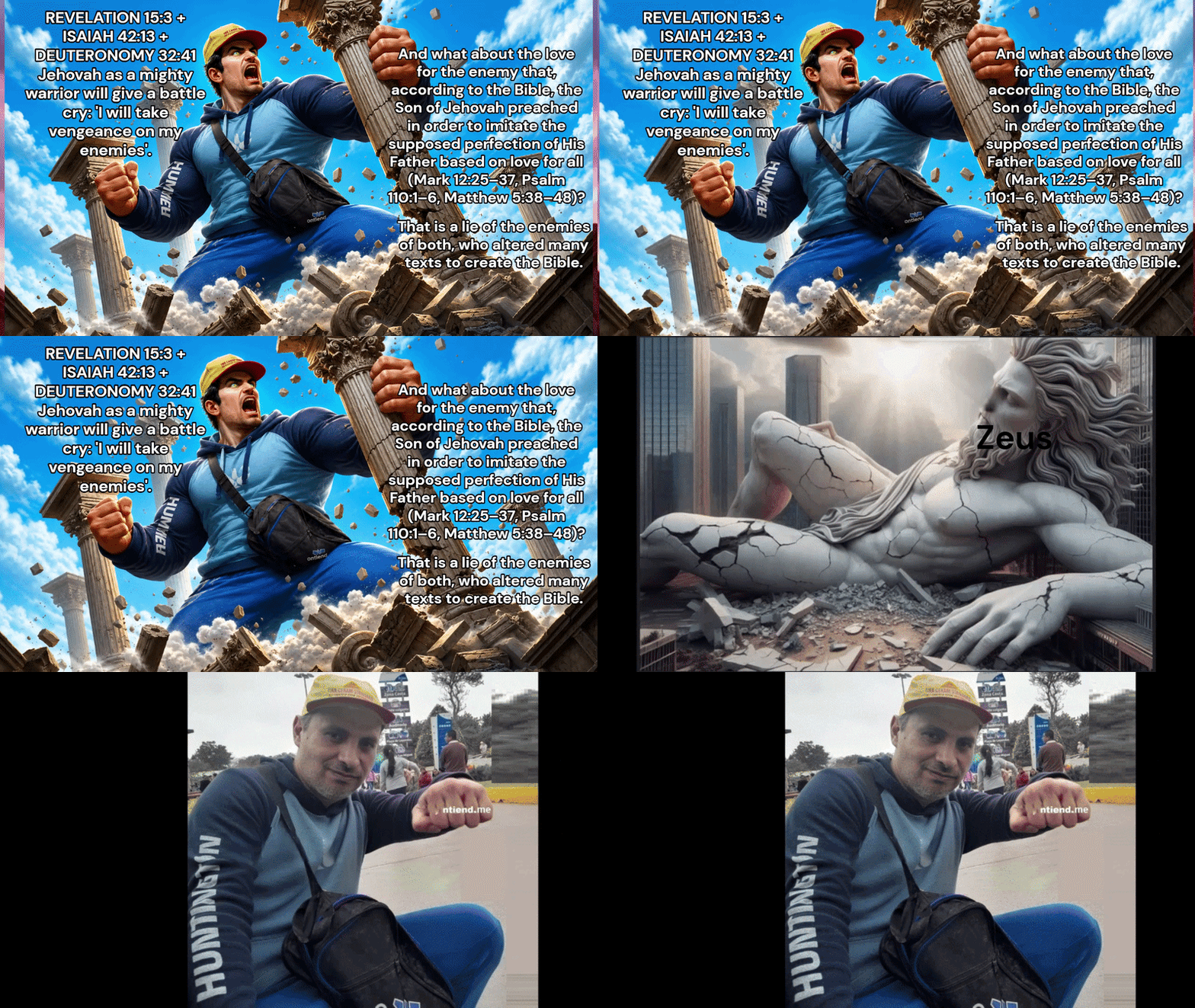
Would they then have to return to life in order to be attacked and die once again? Would they have to return to life in order to accept a dogma created by other peoples foreign to their own, in which they are commanded to worship a man under the absurdity that he is man and at the same time God, and whom imperial tradition furthermore portrays with the same visual appearance as Zeus—the very pagan god worshiped by those who executed them? Would they rise again only to hear the aberration that eating pork no longer defiles (Matthew 15:11, 1 Corinthians 10:27), or that they must bow before a created being (Hebrews 1:6)? Would they truly have to be attacked and die once more? If they had to die again, that new existence would never be eternal life.
To be in heaven is to be with God: ‘To be in heaven’ or with God does not refer to an incorporeal physical place among the clouds, but rather to the condition of being under His protection and of God being with someone. As Psalm 118:6–7 states: ‘The LORD is with me; I will not fear. What can man do to me?’
The dead do not wage war. It is the living righteous who are with God, and being with Him does not initially exempt them from facing war against the hostile on the earth.
In order to divert this chronological line and conceal the awakening of this side, Roman theology took the prophecy of Hosea 6:2 and falsely applied it to the resurrection of Jesus after 48 hours:
Hosea 6:1–2:
‘Come, and let us return to the LORD; for He has torn us, and He will heal us; He has struck us, and He will bind us up. After two days He will give us life; on the third day He will raise us up, and we shall live before Him.’
The prophecy does not describe Jesus returning to life after a literal 48 hours, but rather the chronological scale of a collective people who reincarnate.
Under the prophetic equivalence in which one day represents one thousand years (Psalm 90:4):
After two days (after 48 hours / 2,000 years): Corresponds to the period of dispersion and ignorance that has elapsed since the beginning of this era.
The third day (the third millennium): Is the present period in which we now live, when that righteous side returns to biological life.
One of the pillars of Roman dogma is that salvation is attained solely by believing that Jesus rose from the dead. However, when this premise is compared with the prophetic texts that the Church used to support it, the figure of a resurrected and perfect Jesus collapses completely:
The heir who sins and is punished (Psalm 118): In the parable of the wicked tenants (Matthew 21:33–44), the Church attributes to Jesus the rejected stone of Psalm 118:22. Nevertheless, Psalm 118 describes a righteous man who sins, is punished by God (‘The LORD has chastened me severely, but He has not given me over to death’), and then passes through the gate of righteousness. If this referred to the resurrected Jesus descending from heaven, he could not sin, since he would already know the whole truth. By contrast, if it refers to the righteous seed who reincarnates, its initial passage through ignorance explains why it sins, is rebuked, and is later purified. If he does not return from the clouds, he himself is among that holy seed, but has no way of knowing it, because a new body retains no memories experienced in another body that has already been destroyed.
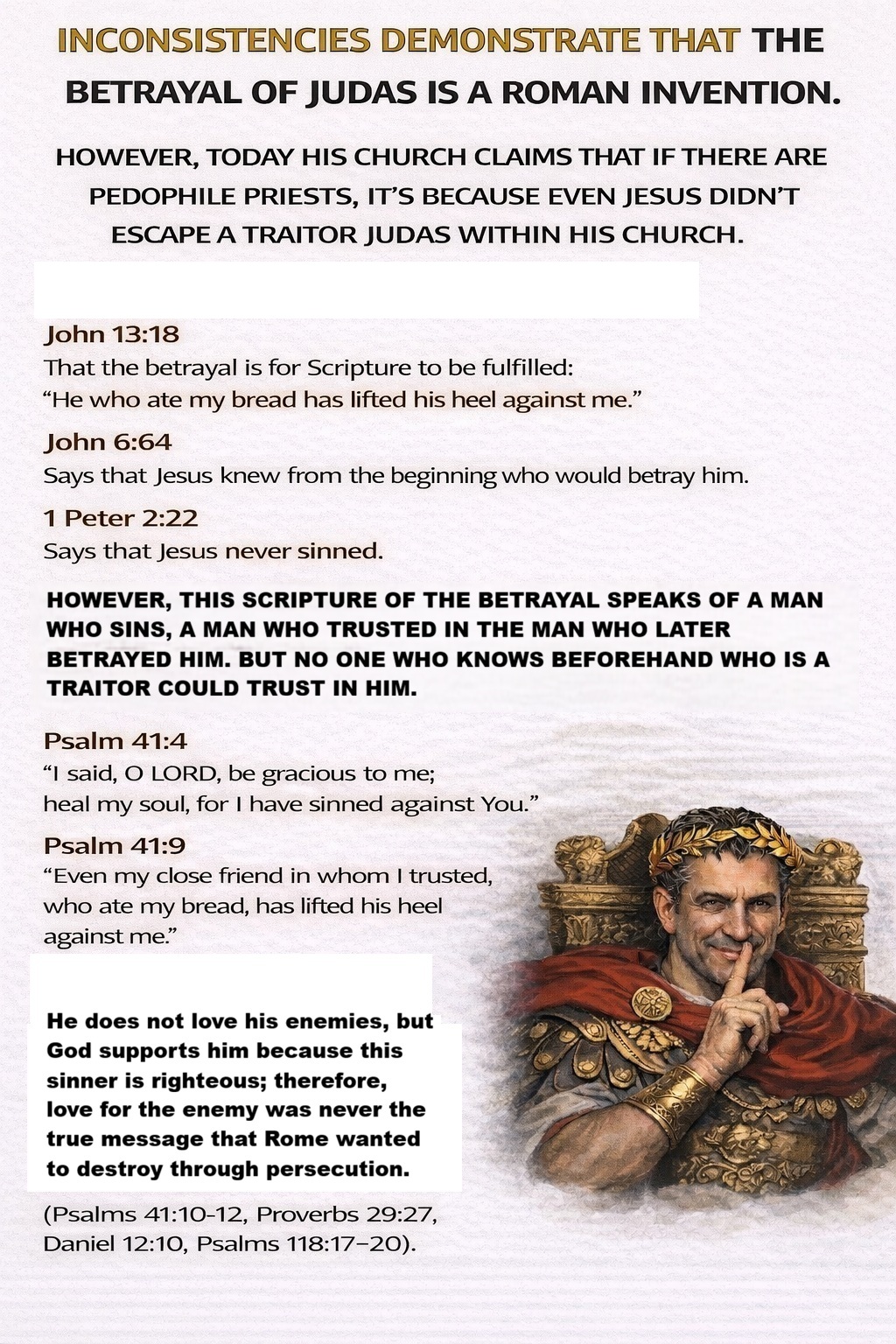
The confession of sin and the betrayal (Psalm 41): Theology claims that Jesus never sinned and knew from the beginning who would betray him. Yet Psalm 41:4, 9—forced by dogma into being a prophecy about Jesus—speaks of a righteous man who admits having sinned (‘LORD, have mercy on me; heal my soul, for I have sinned against You’) and who naively trusted the one who betrayed him (‘Even my own familiar friend, in whom I trusted, who ate my bread, has lifted up his heel against me’). Trusting a traitor never fits the narrative of an omniscient Jesus, but it does fit a righteous man reincarnated on earth.
Multiple betrayers and the myth of Judas (Psalm 109): Psalm 41 does not speak of a single betrayer, but of several enemies. Once this passage collapses as a prophecy fulfilled in Jesus, the deception that Psalm 109 was fulfilled also collapses: a fabricated dogma that invented the figure of a single traitor (Judas). The falsehood of this dogma is exposed within the contradictory accounts of the Romanized text itself—contradictions deliberately created as a strategic device to reinforce the central falsehood while diverting attention toward secondary contradictions that give it a mask of credibility. These texts present two mutually exclusive accounts of Judas’ death: one states that he hanged himself (Matthew 27:5), while the other maintains that he bought a field, fell headlong, and burst open in the middle (Acts 1:18).
Psalm 41 connects directly with Psalm 118: both point to the time of the end. The righteous sinner is not an ethereally resurrected Jesus, but rather the collective righteous who, after reincarnating and falling into deception, are forgiven and purified when they understand the imperial falsehood. By turning away from the dogma, they pass through the gates of righteousness because they are the understanding ones who inherit the earth in this third millennium.
«
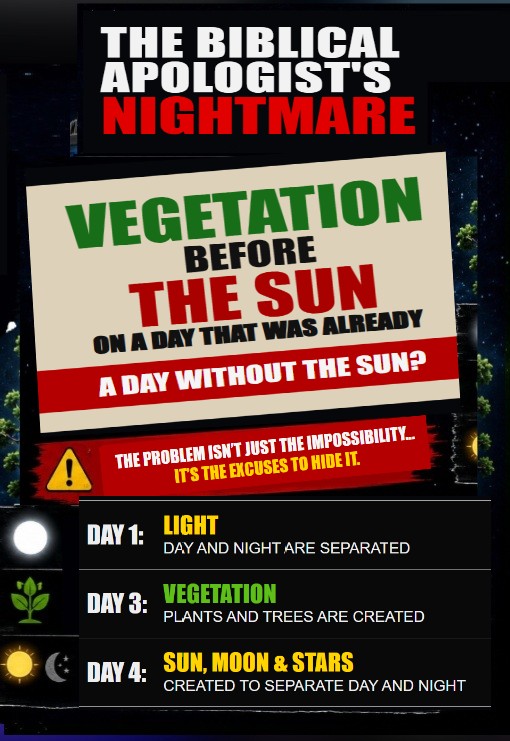
«¿Trees Without Sun? The Contradiction of Genesis 1
The first video questions the biological viability of the story of Jonah from a scientific and logical perspective (the presence of asphyxiating gases such as methane and carbon dioxide in the stomach of a cetacean), using a LEGO-style animation with a satirical and analytical tone. The second video addresses the biological impossibility of photosynthesis without the Sun (plants on day 3 and the Sun on day 4 in Genesis 1).
[The account in the official book of the Roman Empire] ‘I escaped drowning in the sea without drowning inside the whale or being broken down by its acids for 3 days.’ [The one who does not believe that account] ‘I don’t believe you at all. A whale’s stomach does not contain breathable air, but rather asphyxiating digestive gases such as methane and carbon dioxide. A human being would die from asphyxiation within a few minutes. Did you happen to be wearing a special suit with oxygen tanks included at the moment you were supposedly swallowed by the cetacean? Because oxygen tanks did not exist in your time.’
‘I don’t believe you about fruit trees existing before the Sun, either. Are you going to tell me they carried out photosynthesis with a flashlight?’
Greetings from Peru. A few years ago, I met a woman who accused me of being an atheist because I told her that I did not believe everything that is in the Bible. I told her: I believe that God exists, but I do not believe that the Romans were sincere. I believe they adulterated messages and put them into the Bible as official accounts, in order to discredit messages of justice or ridicule them, ridiculing those messages of justice that they never accepted. I do not believe that a contradictory message is synonymous with the infallible word of God. For example: In Genesis 1, concerning creation, it says that God made the plants, the trees that bear fruit, and every green herb on the 3rd day, but it was not until the 4th day that He made the sun, the stars, and the moon. That does not add up. How can fruit-bearing trees exist without the sun that allows them to carry out photosynthesis? No one can convince me that an incoherent argument, a story that does not add up, is synonymous with the infallible word of God.
«
«Walking on the edge of death along the dark path, but looking for the light, interpreting the lights projected on the mountains so as not to make a false step, to avoid death. █
Night was falling on the main road.
A blanket of darkness covered the winding path that wound through the mountains.
He did not walk aimlessly.
His goal was freedom, but the journey had only just begun.
With his body numb from the cold and his stomach empty for days,
he had no company but the elongated shadow cast by the headlights of the trucks that roared beside him,
advancing without stopping, indifferent to his presence.
Every step was a challenge,
every curve a new trap from which he had to emerge unscathed.
For seven nights and mornings,
he was forced to advance along the thin yellow line of a narrow road with just two lanes,
while trucks, buses and trailers whizzed by just inches from his body.
In the darkness, the deafening roar of engines enveloped him,
and the lights of trucks coming from behind cast their glow on the mountain in front of him.
At the same time, other trucks approached in the opposite direction,
forcing him to decide in fractions of a second
whether to pick up the pace or remain still in his precarious crossing,
where every movement meant the difference between life and death.
Hunger was a beast that devoured him from the inside,
but the cold was no less merciless.
In the sierra, the early hours of the morning were invisible claws that penetrated to the bones.
The wind enveloped him with its icy breath,
as if it wanted to extinguish the last spark of life that remained to him.
He took refuge where he could,
sometimes under a bridge,
other times in a corner of concrete that offered him a minimum of shelter.
But the rain was unforgiving.
Water seeped into his torn clothes,
sticking to his skin and stealing what little warmth he still had.
The trucks continued their march,
and he, stubbornly hoping that someone would feel sorry,
raised his hand, waiting for a gesture of humanity.
But the drivers drove on.
Some with looks of contempt,
others simply ignoring him, as if he were a ghost.
Every now and then, a compassionate soul would stop and offer him a quick ride,
but they were few.
Most saw him as a nuisance,
a shadow on the road,
someone not worth helping.
On one of those endless nights,
desperation drove him to search for food among the scraps left by travelers.
He was not ashamed to admit it:
he fought for food with pigeons,
snatching pieces of hardened biscuits before they could make them disappear.
It was an unequal fight,
but he was determined:
he was not willing to kneel before any image,
nor to accept any man as ‘only lord and savior’.
He was not willing to please those sinister individuals
who had already kidnapped him three times over religious differences,
who with their slanders had led him to walk that yellow line.
At another time, a kind man offered him a piece of bread and a drink.
A small gesture,
but in his pain,
that kindness was a balm.
But indifference was the norm.
When he asked for help,
many would walk away,
as if they feared that his misery was contagious.
Sometimes, a simple ‘no’ was enough to extinguish all hope,
but on other occasions, contempt was reflected in cold words or empty looks.
He didn’t understand how they could ignore someone who could barely stand,
how they could watch a man collapse without batting an eyelid.
And yet, he kept going.
Not because he had the strength,
but because he had no other choice.
He continued down the road,
leaving behind him miles of asphalt,
nights without rest and days without food.
Adversity hit him with everything it had,
but he resisted.
Because deep down,
even in the most absolute desperation,
the spark of survival still burned within him,
fueled by the desire for freedom and justice.
Psalm 118:17
‘I will not die, but I will live to proclaim the works of Jehovah.
18 Jehovah has chastened me severely, but He has not given me over to death.’
Psalm 41:4
‘I said, ‘Jehovah, have mercy on me
and heal me, for I confess with repentance that I have sinned against You.»
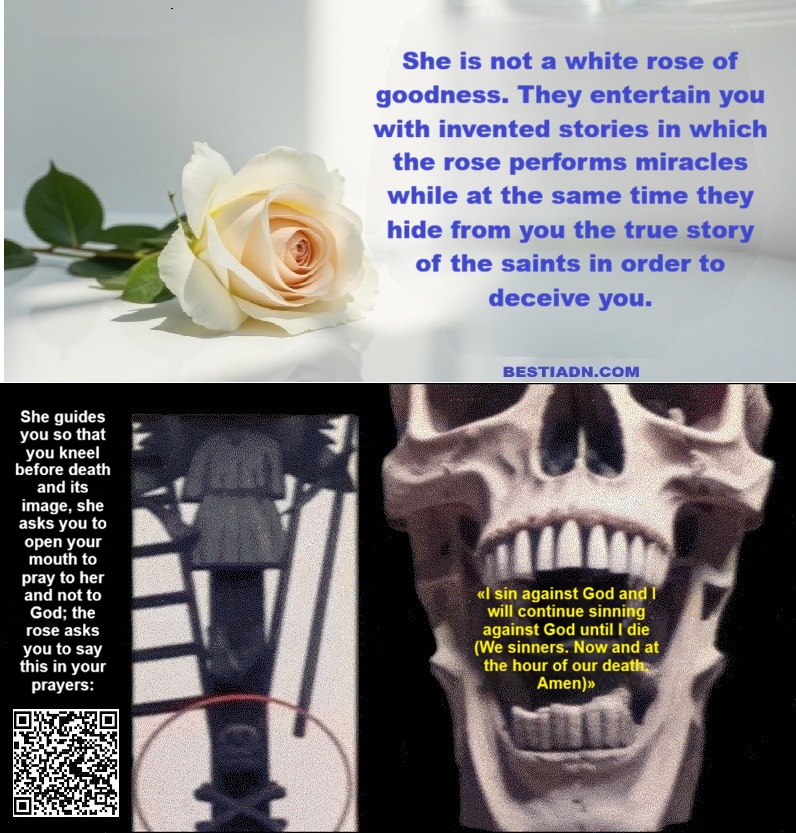
Job 33:24-25
‘God will have mercy on him and say, ‘Deliver him from going down to the pit; I have found a ransom;
25 his flesh shall become fresher than in childhood, and he shall return to the days of his youth.»
Psalm 16:8
‘I have set Jehovah always before me;
because He is at my right hand, I will not be shaken.’
Psalm 16:11
‘You will show me the path of life;
in Your presence, there is fullness of joy;
at Your right hand, there are pleasures forevermore.’
Matthew 7:14 For small is the gate and narrow the way that leads to life, and few are those who find it.
Leviticus 21:13 He shall take a virgin as his wife. 14 He shall not take a widow, a divorced woman, a disgraced woman, or a prostitute, but he shall take a virgin as his wife from among his own people, 15 so that he will not profane his offspring among his people; for I, the Lord, am the one who sanctifies them.
Isaiah 51:7 Listen to me, you who know righteousness, you people in whose hearts is my law: Do not fear the reproach of men, nor be dismayed by their insults. 8 For the moth will eat them up like a garment, and the worm will devour them like wool; but my righteousness will stand forever, and my salvation through all generations.
Psalm 119:1 Blessed are those who are consistent in their way, who walk according to the law of Jehovah.
Deuteronomy 19:18 The judges shall investigate thoroughly, and if that witness is found to be false and has falsely accused his brother, 19 then you shall do to him as he intended to do to his brother, and you shall purge the evil from among you. 20 Those who remain shall hear and be afraid, and shall no longer commit such wickedness among you. 21 You shall show him no pity; life for life, eye for eye, tooth for tooth, hand for hand, foot for foot.

Psalm 119:34 Give me understanding, and I will keep your law, and obey it with all my heart.
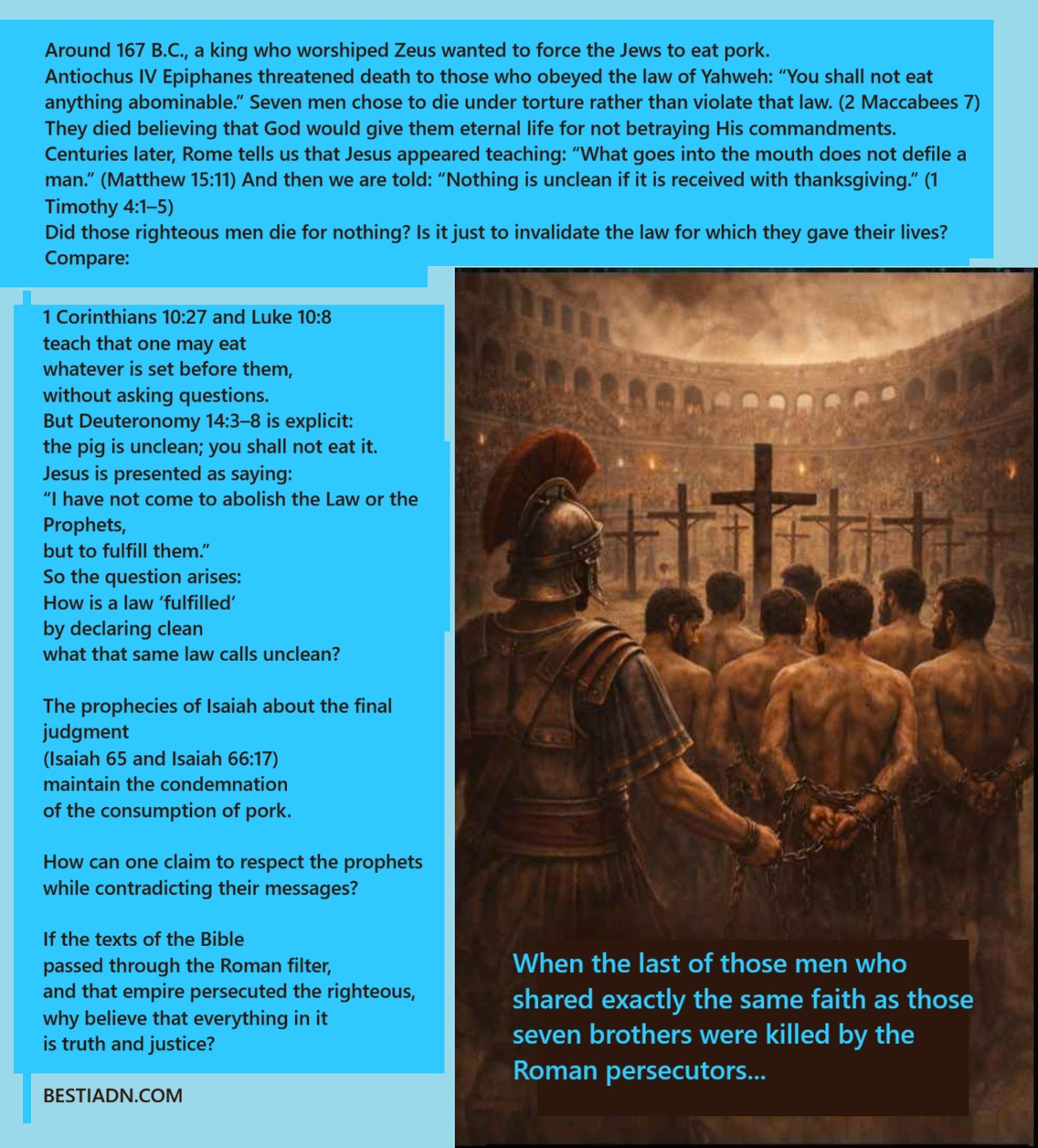
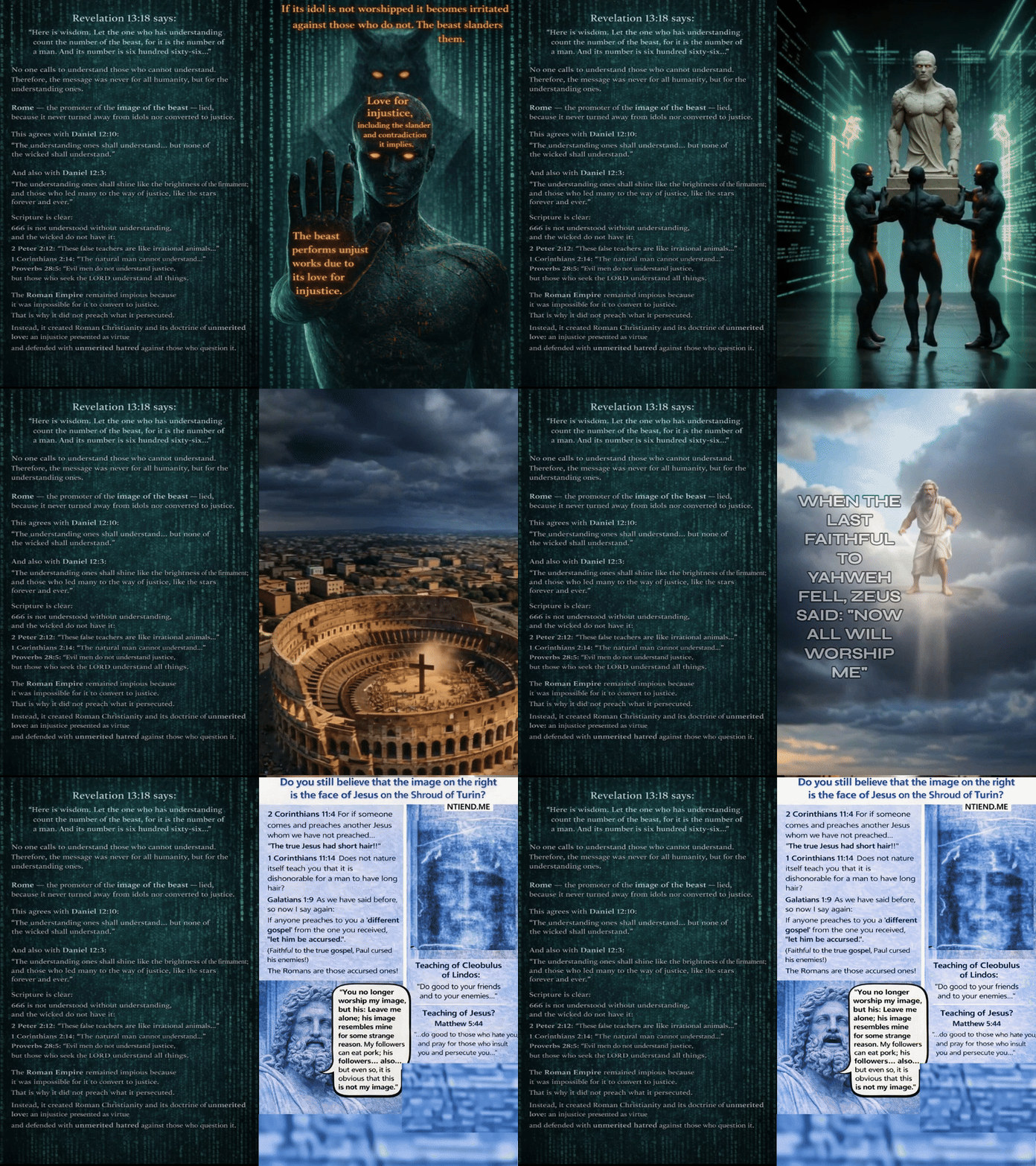
Daniel 12:3 Those who are wise will shine like the brightness of the heavens, and those who lead many to righteousness, like the stars for ever and ever.
Psalm 41:11-12
‘By this, I will know that You are pleased with me:
if my enemy does not triumph over me.
Micah 7:10 And my enemy shall see it, and shame shall cover her; she who said to me, ‘Where is Jehovah your God?’ My eyes shall see her; now she shall be trampled down like mud in the streets.
Psalms 41:12 As for me, You uphold me in my integrity
and set me in Your presence forever.’
Revelation 11:4
‘These witnesses are the two olive trees and the two lampstands standing before the God of the earth.’
Isaiah 11:2
‘The Spirit of Jehovah shall rest upon him:
the Spirit of wisdom and understanding, the Spirit of counsel and might, the Spirit of knowledge and the fear of Jehovah’

I made the mistake of defending the faith in the Bible, but out of ignorance. However, now I see that it is not the guiding book of the religion that Rome persecuted, but of the one it created to please itself with celibacy. That’s why they preached a Christ who doesn’t marry a woman, but rather His church, and angels who, despite having male names, do not look like men (draw your own conclusions). These figures are akin to the false saints—plaster-statue kissers—and similar to the Greco-Roman gods because, in fact, they are the same pagan gods under different names.
What they preach is a message incompatible with the interests of true saints. Therefore, this is my penance for that unintentional sin. By denying one false religion, I deny them all. And when I finish doing my penance, then God will forgive me and bless me with her, with that special woman I need. Because, although I don’t believe in the entire Bible, I do believe in what seems right and consistent to me within it; the rest is slander from the Romans.
Proverbs 28:13
‘He who covers his sins will not prosper, but whoever confesses and forsakes them will have mercy from the Lord.’
Proverbs 18:22
‘He who finds a wife finds a treasure and receives favor from the Lord.’
I seek the Lord’s favor embodied in that special woman.
She must be as the Lord commands that she be.
If this upsets you, it is because you have lost:
Leviticus 21:14
‘A widow, or a divorced woman, or a defiled woman, or a prostitute, he shall not marry these, but he shall marry a virgin from his own people.’
To me, she is glory:
1 Corinthians 11:7
‘Woman is the glory of man.’
Glory is victory, and I will find it with the power of light. Therefore, even though I don’t know her yet, I have named her: Light Victory.
And I nicknamed my web pages ‘UFOs’ because they travel at the speed of light, reaching corners of the world and shooting out rays of truth that strike down the slanderers. With the help of my web pages, I will find her, and she will find me.
When she finds me and I find her, I will tell her this:
‘You have no idea how many programming algorithms I had to devise to find you. You can’t imagine all the difficulties and adversaries I faced to find you, my Light of Victory.
I faced death itself many times:
Even a witch pretended to be you. Imagine, she told me she was the light, despite her slanderous behavior. She slandered me like no one else, but I defended myself like no one else to find you. You are a being of light; that’s why we were made for each other!
Now let’s get out of this damn place…
So this is my story. I know she will understand me, and so will the righteous.


Isaiah 51:6 Lift up your eyes to the heavens, and look down upon the earth; for the heavens shall vanish away like smoke, and the earth shall grow old like a garment, and its inhabitants shall perish in like manner; but my salvation shall be forever, and my righteousness shall not perish.
Psalms 16:11
‘You will show me the path of life;
in your presence there is fullness of joy;
at your right hand are pleasures forevermore.’
Matthew 7:13-14 Enter through the narrow gate; for wide is the gate and broad is the way that leads to destruction, and many are those who enter through it; for narrow is the gate and difficult is the way that leads to life, and few are those who find it.
Leviticus 21:13 He shall take a virgin as his wife. 14 He shall not take a widow, or a divorced woman, or one who has been defiled, or a prostitute; but he shall take a virgin of his own people as his wife, 15 so that he may not profane his offspring among his people; for I, the LORD, am the one who sanctifies them.
Psalms 118:20 This is the gate of the LORD; the righteous shall enter through it.
Proverbs 19:14 House and riches are an inheritance from fathers, but a prudent wife is from the LORD.
Daniel 12:13 But as for you, Daniel, go your way until the end; you shall rest, and then you shall rise to receive your inheritance at the end of the days.
Daniel 12:9 He replied, ‘Go your way, Daniel, for these words are closed up and sealed until the time of the end.’
Revelation 10:5-7 And the angel whom I saw standing on the sea and on the earth lifted up his hand to heaven, 6 and swore by him who lives forever and ever, who created heaven and the things in it, and the earth and the things in it, and the sea and the things in it, that there would be no more delay, 7 but in the days of the voice of the seventh angel, when he is about to sound the trumpet, the mystery of God will be fulfilled, as he declared to his servants the prophets.
Daniel 12:7 And I heard the man clothed in linen, who was above the waters of the river; he raised his right hand and his left hand toward heaven and swore by him who lives forever that it would be for a time, times, and half a time. And when the shattering of the power of the holy people is completed, all these things shall be fulfilled.
And when I find her, I will say to her: ‘Thank you for finding me, virgin of the gate, come, embrace me, and let me give you a kiss on the mouth…’
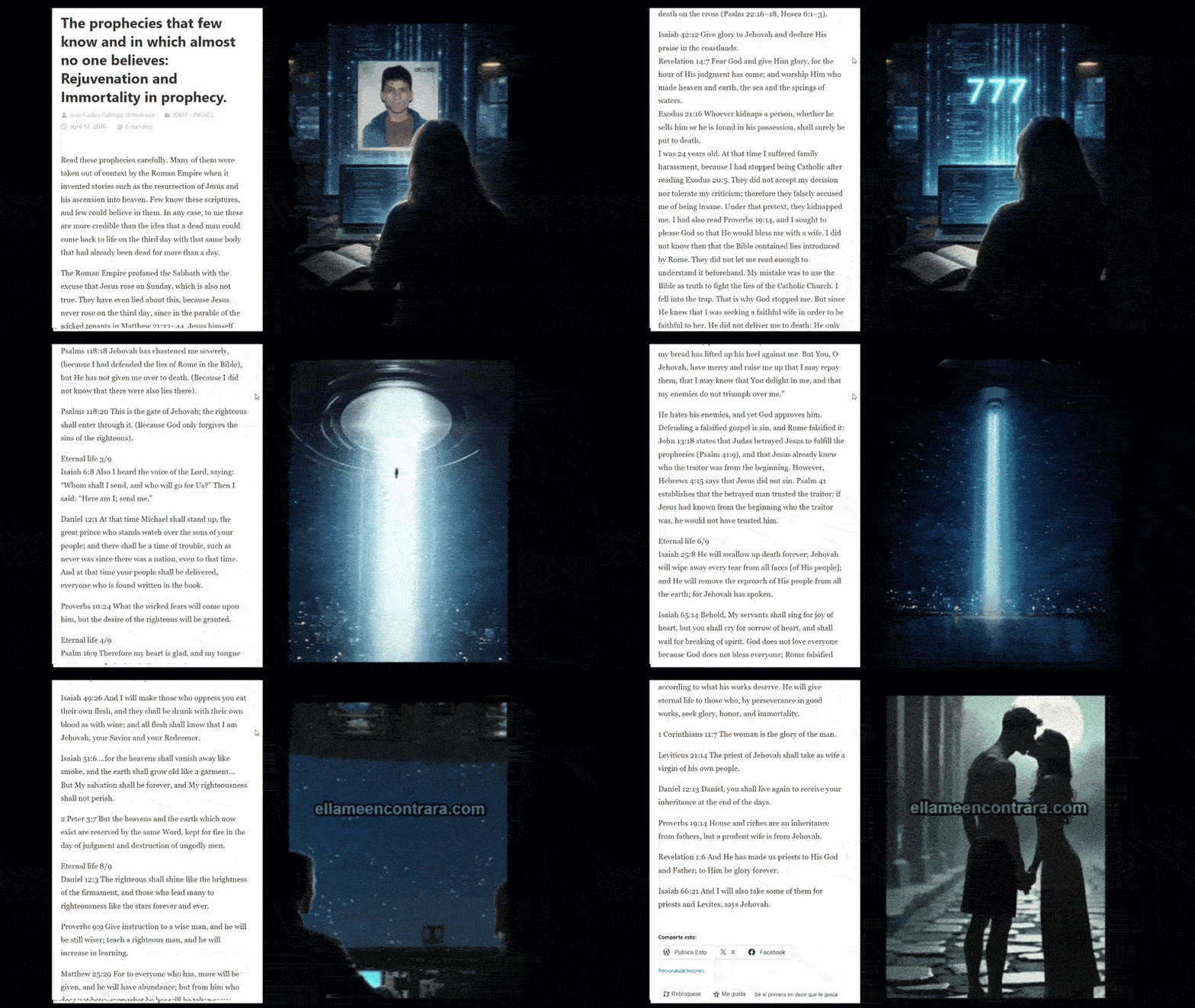

I have been a computer programmer, I like logic, in Turbo Pascal I created a program capable of producing basic algebra formulas at random, similar to the formula below. In the following document in .PDF you can download the code of the program, this is proof that I’m not stupid, that’s why the conclusions of my research should be taken seriously. https://ntiend.me/wp-content/uploads/2026/06/math21.pdf
If Z+41=40 then Z=-1
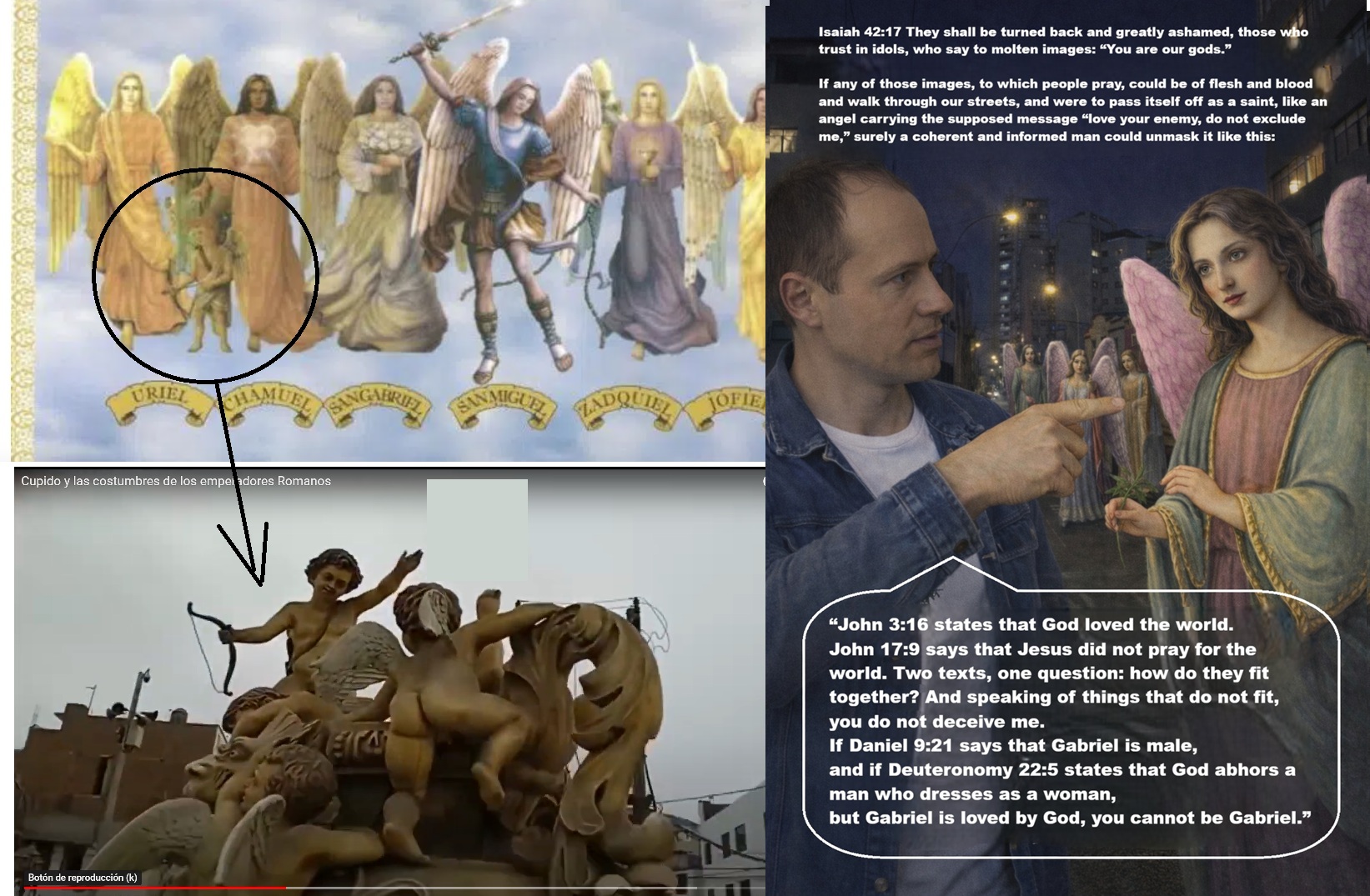
«Cupid is condemned to hell along with the other pagan gods (The fallen angels for their rebellion against justice, sent to eternal punishment). █
Quoting these passages does not mean defending the entire Bible. If 1 John 5:19 says that “the whole world is under the power of the evil one,” but rulers swear on the Bible, then the Devil rules with them. If the Devil rules with them, then fraud also rules with them. Therefore, the Bible contains part of that fraud, camouflaged among truths. By connecting those truths, we can expose their deceptions. Righteous people need to know these truths so that, if they have been deceived by lies added to the Bible or other similar books, they can free themselves from them.
Daniel 12:7 And I heard the man clothed in linen, who was above the waters of the river, when he raised his right hand and his left hand to heaven and swore by Him who lives forever that it shall be for a time, times, and half a time. And when the power of the holy people is completely shattered, all these things shall be finished.
Considering that ‘Devil’ means ‘Slanderer,’ it is natural to expect that the Roman persecutors, being the adversaries of the saints, later bore false witness against the saints and their messages. Thus, they themselves are the Devil, and not an intangible entity that enters and exits people, as they made us believe precisely with passages like Luke 22:3 (“Then Satan entered Judas…”), Mark 5:12-13 (the demons entering the pigs), and John 13:27 (“After the morsel, Satan entered him”).
This is my purpose: to help righteous people not waste their power believing in the lies of impostors who have adulterated the original message, which never asked anyone to kneel before anything or pray to anything that had ever been visible.
It is no coincidence that in this image, promoted by the Roman Church, Cupid appears alongside other pagan gods. They have given the names of the true saints to these false gods, but look at how these men dress and how they wear their long hair. All this goes against faithfulness to God’s laws because it is a sign of rebellion, a sign of the fallen angels (Deuteronomy 22:5).
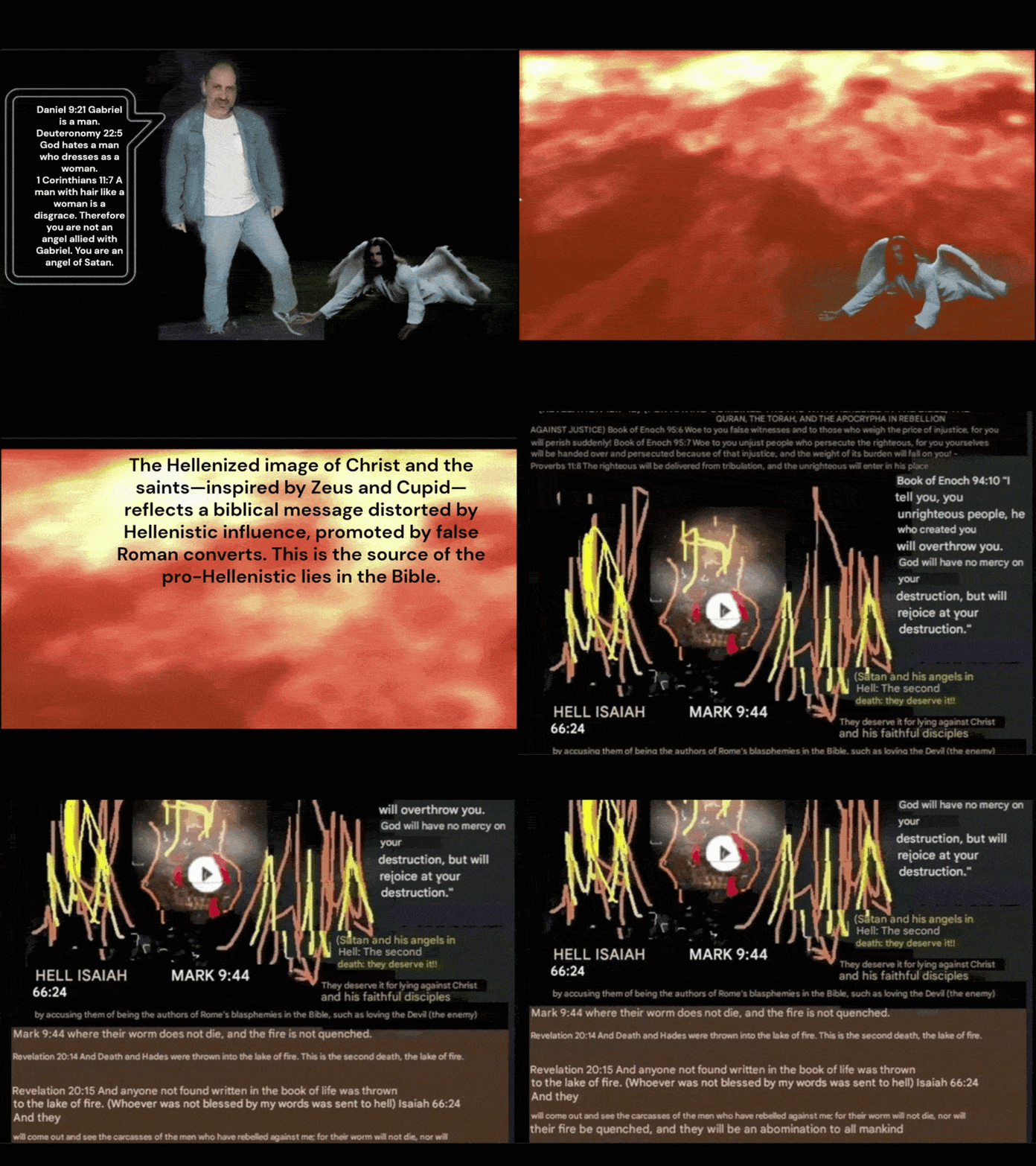
The serpent, the devil, or Satan (the slanderer) in hell (Isaiah 66:24, Mark 9:44). Matthew 25:41: “Then he will also say to those on his left: ‘Depart from me, you cursed, into the eternal fire that has been prepared for the devil and his angels’.” Hell: the eternal fire prepared for the serpent and his angels (Revelation 12:7-12), for having combined truths with heresies in the Bible, the Quran, the Torah, and for having created false forbidden gospels that they called apocryphal, to give credibility to lies in the false sacred books, all in rebellion against justice.
Book of Enoch 95:6: “Woe to you, false witnesses and to those who weigh the price of injustice, for you will perish suddenly!” Book of Enoch 95:7: “Woe to you, unjust ones who persecute the righteous, for you yourselves will be handed over and persecuted because of that injustice, and the burden of your guilt will fall upon you!” Proverbs 11:8: “The righteous is delivered from trouble, and the wicked comes in his place.” Proverbs 16:4: “The Lord has made all things for Himself, even the wicked for the day of doom.”
Book of Enoch 94:10: “Unjust ones, I say to you that He who created you will overthrow you; upon your ruin, God will have no mercy, but rather, God will rejoice in your destruction.” Satan and his angels in hell: the second death. They deserve it for lying against Christ and His faithful disciples, accusing them of being the authors of Rome’s blasphemies in the Bible, such as love for the devil (the enemy).
Isaiah 66:24: “And they shall go out and look upon the corpses of the men who have rebelled against me; for their worm shall never die, nor shall their fire be quenched, and they shall be abhorrent to all flesh.” Mark 9:44: “Where their worm does not die, and the fire is never quenched.” Revelation 20:14: “Then Death and Hades were cast into the lake of fire. This is the second death: the lake of fire.”
Word of Satan: ‘Rome stopped worshiping my image and walking in my path; now it follows the one who denied me. Why is it that his image looks so much like mine and that his path demands that they love me… even though I am the enemy?’
He who learns to obey before statues ends up killing or dying without thinking about useless wars.
The true lamb turns away from the meat, but the wolf disguised as a lamb lunges at it.
Word of Satan: ‘Blessed are the blind… because they will never notice the chains with which I bind them.’
The false prophet defends the ‘prosperity gospel’: ‘Sow in my pocket and God will make you reap in yours — curiously, only mine never runs empty.’
Word of Satan: ‘Whoever receives the wolf with patience will see that ferocity turns into obedience without betrayal.’
A mute idol and a loud prophet—guess which one steals your life.
Word of Satan: ‘Do to others what you want them to do to you… even if some of them are unjust and repay good with evil.’
God’s love is neither blind nor complicit. He does not embrace those who hate justice. He loves the righteous but rejects the wicked. And even if the world blesses the wicked, God will cut them off.
Wolves say ‘nobody is perfect’ while planning their next abuse without remorse.

Que ressentait saint Pierre envers ses ennemis ? Amour ou Haine ? https://penademuerteya.com/2026/09/13/que-ressentait-saint-pierre-envers-ses-ennemis-amour-ou-haine/
Yunus balinanın içinde ne soludu? Büyük balık mı, büyük aldatmaca mı? https://ellameencontrara.com/2026/06/09/yunus-balinanin-icinde-ne-soludu-buyuk-balik-mi-buyuk-aldatmaca-mi/
Word of Satan to his priests: «When they ask you for evidence, give them authority; when they ask you for logic, give them tradition; when they ask you for coherence, give them mystery.» Where the unjust rules, injustice reigns. There is no way to justify it.»