

Are All Sinners Equal in the Eyes of God?█
[Satan] ‘The devil, like a lion, seeks to confuse you. We do not worship images; we venerate them’.
[The man] ‘The devil charges them for the lie that they will be saved even if they do not stop worshipping creatures’.
If you do the same thing that is described and condemned, even if you use a different verb, you are still doing what is condemned.

Changing the form or giving sacred names to images does not change the act. Calling an image or statue by another name does not change the fact that it is an image or a statue. If you kneel to pay homage to it, lower your gaze before it, or burn incense to it, you do not please God: you please the idolatrous priest. If ancient Rome, which murdered the saints, continued doing this, there are no grounds to believe that it respected the message or that all the books of the Bible that emerged from its councils are free from its adulterations. I will point out one clue: you will never find a passage in the Gospels in which Jesus is shown describing what idols are and what idolatry is. Yet, according to the Bible’s own texts, idolatry was clearly described by Isaiah and Habakkuk.
Isaiah described how an image is carved from a tree, before which a man bows down to plead with it (Isaiah 44). Today, we are told that, by doing exactly that, they are not committing idolatry because, in reality, they are praying to God. Is God deaf if a piece of wood is not used to speak to Him?… Cynicism is the main characteristic of every false prophet. Habakkuk also describes how mute images are useless and curses those who pray to them (Habakkuk 2:18–19).
The same Bible tells us that, because of his words, Jesus was mistaken for the ancient prophets (Matthew 16:13–14). If he was mistaken for the prophets, it is logical that his messages would align with theirs. But isn’t it strange that there is not a single parable or message attributed to him that describes and condemns, so clearly, the worship of statues or images? I believe he did speak clearly about this, but Rome decided to remove that text because it made it uncomfortable.
It is also very strange that in Acts and other books of the New Testament, we do not see a clear description of what it means to worship images as idols. The only direct reference in the New Testament is in Revelation 9:20:
‘And the rest of the men who were not killed by these plagues still did not repent of the works of their hands, nor did they stop worshipping demons and images of gold, silver, bronze, stone, and wood, which can neither see, nor hear, nor walk’.
Despite this, the hypocritical guide says that they know their images are not God and that they know they cannot hear, speak, feel, or walk, but that even if people kneel before them, they do not worship them: they merely ‘venerate’ them.
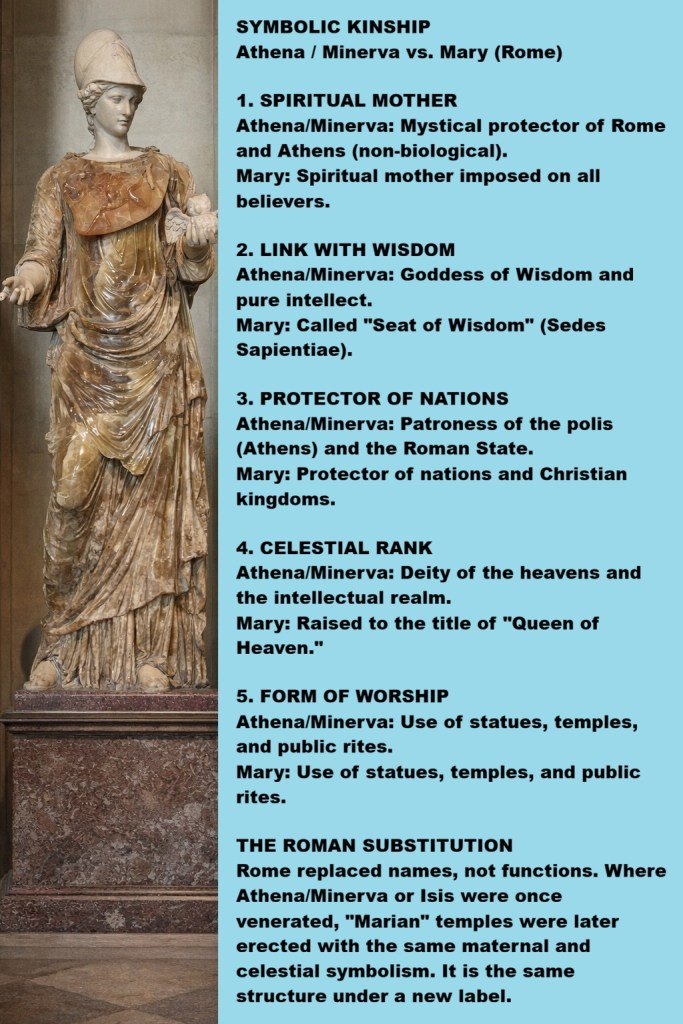
As I told you, I do not place all my trust in a book that has been filtered by the empire of hypocrites. Basically, the Church of Rome has managed to get people to respect and worship its own monuments under different names: the supposed image of Jesus, a copy of the image of Zeus (Jupiter); the supposed image of Saint Michael, a copy of the Roman soldier whom they worshipped as the ‘god Mars’, wearing a military uniform and armor.
Given that canonization comes from that empire, it is foolish to trust blindly in its absolute faithfulness.
Where Are Jesus’ Messages About Idolatry?
When the practice of kneeling before statues, burning incense to them, or lowering one’s gaze before them is challenged, the cleric’s response is always the same semantic evasion: ‘We do not worship them; we only venerate them’. They change the verb, dress up the name, and pretend that the act is no longer idolatry.
However, if we examine the texts under a magnifying glass, a major historical anomaly emerges: the prophets of the Old Testament did not beat around the bush. Isaiah and Habakkuk described the harsh reality of idols in great detail: the cut log, the carved wood, the mute object that cannot see, hear, or walk, and the absolute condemnation of those who bow down before it. If Jesus was mistaken by the crowds for one of the ancient prophets, as Matthew 16 recounts, his discourse should have followed that same direct and unambiguous line.
So why do the Gospels and the epistles of Peter, Paul, and John maintain such a strange silence about the physical description of idolatry? The only direct allusion in the entire New Testament appears in isolation in Revelation 9:20, but it is insufficient given the scale of the problem. Is it logical that the apostles would have omitted such a fundamental warning?
This is where we must stop swallowing the official story whole. Through strategic filtering, the Roman Empire removed all messages that were uncomfortable or too explicit and that affected its interests. It is no coincidence that the Church of Rome recycled the monuments of imperial paganism under new names (the image of Zeus turned into that of Jesus, or the soldier Mars transformed into Saint Michael) to keep the masses kneeling.
Inevitable conclusion: Jesus never founded this religion. It was the Roman Empire that built Christianity upon incomplete texts that had been tampered with and adapted to suit its own purposes.
Proverbs 28:13 He who conceals his sins will not prosper, but whoever confesses and forsakes them will find mercy.
Do you confess that you have sinned through idolatry? I do confess it: I have sinned through idolatry. I knelt before Catholic images and treated them as idols are treated, just as thousands of people do before priests who tell them: ‘You do not worship these images; you only worship God under our guidance. We venerate these images affectionately, just as we treat a family photograph with affection’.
But look at the difference: you can tear up a family photograph when you decide you no longer need it, and nothing happens. Nobody condemns you; nobody calls you a ‘heretic’ for doing so. But an idolized image is never broken by the person who worships it, and there are people who will call you a ‘heretic’ if you do.
Do you know when I stopped committing the sin of worshipping images? When I informed myself and read Exodus 20:5, it became clear to me what the sin was, and I stopped doing it. But today, those who know that message look for five legs on a cat to keep demanding that people bend their knees before their images.
God loves those who have dignity and are capable of learning not to bend the knee to anything or anyone.
Look at how, just as in Exodus 20, God is not portrayed as loving everyone or condemning everyone. Isaiah 43:4 says: ‘Since you are precious in my eyes, worthy of honor, and I love you, I will give other men in your place, and other peoples in exchange for your life’.
Then we have the message in Daniel 12:10, where some sinners are described as being cleansed of their sins, while other sinners are not cleansed of their sins:
Daniel 12:10 Many shall be purified, made white, and refined; the wicked shall act wickedly, and none of the wicked shall understand, but the wise shall understand.
The wicked guides, on the contrary, make you sin in word and deed. Not only do they tell you that you do not idolize their images when, in reality, you do idolize them, but they also condemn you with your own words by declaring you guilty of your sin, by saying that you have «great guilt» and that you «will continue sinning», not only now, but even at «the hour of your death».
Furthermore, they teach you to sin while you say it, because they teach you to direct that prayer not to God, but to an «intermediary», as if God needed spokespeople to inform Him of people’s prayers, as if God were incapable of hearing them directly. In other words, they teach you to have other gods, because polytheists worshipped their various gods by praying to them. Then they tell you that they worship only God.
Did the supposed intermediary create the universe? Yet they demand that you direct your prayers not to one, but to several intermediaries, whom they call «saints» to disguise what they are. Not only that, but the empire that justified the worship of its gods, renamed after saints, invented and/or distorted messages that the empire itself canonized to justify praying to created beings.
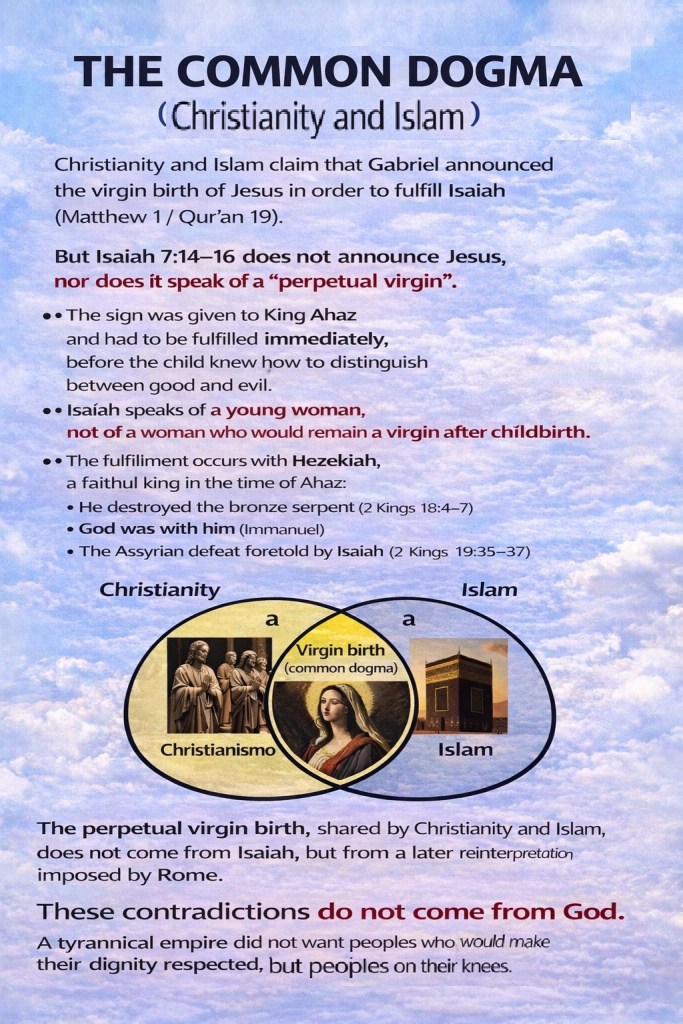

Then the question arises, along with its answer: Are all sinners equal in the eyes of God? No.
@JoseGalindoMMXXVI
2 hours ago (edited) Luis Toro, I listen to you in your video and see how you try to relativize the unacceptable. You attempt to construct an institutional defense using theological sleight of hand, but your arguments collapse under their own weight. Here I respond point by point to the exact moments in your intervention:
At minute 03:57, you come out saying that the problem of pederasty is not exclusive to the Church, mentioning that it also occurs among pastors, lawyers, or doctors, and explaining it on the premise that «the priest is still a human being, a sinful man». My response: With that argument that «we are all sinners», you seek to hide child rapists within the common lot of humanity, as if all human beings felt tempted to commit such wickedness. That is an intolerable slander against the just people who do exist in humanity. Not all human beings are predators. If we examine the Scriptures carefully, not all sinners are equal. A predator (a wolf: a child rapist) is not the same as a lost sheep (a righteous person who, for example, worships images out of ignorance, someone who sins through ignorance). You teach the righteous person Exodus 20:5, and he immediately abandons the sin —he is one of those spoken of in Daniel 12:10 as being cleansed of their sins. But if you teach a wolf Exodus 20:5, he will insist on worshipping images, saying that he does not «worship» them, but merely venerates them, always looking for excuses to repeat the act that is described and condemned: bowing down before the image and paying it homage.
If you read Psalm 118, you will see that the righteous person is punished; if it were impossible for the righteous to sin, there would be no need for punishment. Notice that he later passes through the gates through which only the righteous pass, but «the nations» (as the unrighteous are called) are destroyed; the destruction is the result of their recurring and deliberate sins. If God did not spare the men of Sodom who wanted to sexually assault Lot and the angels, why do you think God will spare those who rape children? It is impossible for God to forgive wickedness; God forgives the righteous person’s error arising from ignorance, but He never forgives the wickedness of the unrighteous. That is why Proverbs 16:4 says: «The Lord has made everything for Himself, even the wicked for the day of evil».
At minute 06:15, you dare to say that, just as there was one Judas among every twelve apostles, there will be a «Judas» among every twelve priests. My response: It must not be that way! You are trying to ask people to accept corruption by decree. If a Church calls itself holy, there must be nothing corrupt within it, no idol, no false teaching, and no depraved person hiding in religious habits. We are told that Judas betrayed Jesus, but I maintain that this story is false because it was told by the Empire that murdered the righteous man and because among the righteous there are never any traitors, nor could the unrighteous infiltrate their ranks without their rejection of messages of justice giving them away.
And, oh, what a coincidence! They denied the justice of an eye for an eye, but attributed that denial to their victim, portraying Jesus as a preacher of turning the other cheek to the enemy instead of defending the principle of an eye for an eye. If God never makes mistakes, then He did not make a mistake with the principle of an eye for an eye; Rome was wrong to reject it, and errors have consequences. Its deliberate sin against justice will never be forgiven. Do not misunderstand me: I am not defending the «Old Testament» over the «New Testament»; the Empire respected neither the integrity of the branches nor that of the root.
At minute 10:09, you claim that if a pederast priest repents, God forgives him even if the laws of the world do not, addressing the issue of forgiveness for the transgressor. My response: God does not forgive the wicked because He knows that the wicked never repent and that He did not create them to become righteous. Scripture confirms this in Revelation 9:20: «And the rest of mankind, who were not killed by these plagues, did not even then repent of the works of their hands, nor did they stop worshipping the images of gold, silver, bronze, stone, and wood, which cannot see, hear, or walk». That is why Daniel 12:10 is clear, and that is why Psalm 5:5–6 says: «The foolish shall not stand in Your sight; You hate all workers of iniquity. You shall destroy those who speak falsehood; the Lord abhors the bloodthirsty and deceitful man».
They distract us with secondary contradictions that do not disprove the fundamental contradiction. Let us consider an example. In Matthew 26:48–49 and Mark 14:44–45, Judas had agreed to identify Jesus with a kiss: «The one I kiss, that is he». By contrast, John 18:4–8 recounts that Jesus stepped forward, asked whom they were seeking, and, when they answered «Jesus of Nazareth», replied: «I am he». Both accounts present significant differences. If Judas had to identify Jesus with a kiss, why did Jesus step forward and identify himself? Conversely, if Jesus identified himself to those who had come to arrest him, why was there any need for Judas to identify him with a kiss?
However, these are not the most important contradictions. The fundamental problem is that we are asked to accept that the betrayal took place so that a prophecy would be fulfilled. I believe Rome invented the story of a traitor among the saints in order to usurp their place and establish a precedent for the members of its Church. Thus, whenever some atrocity was discovered, they could resort to the story and say: «If even Jesus had a traitor among his own, what can be expected of us?»
One of the reasons I claim that no such betrayal took place is this: Psalm 41 speaks of a man who acknowledges his sin and of a close companion who shares his bread and betrays him. How does that figure fit Jesus, whom they portray as a man who never sinned? The Bible itself states that Jesus committed no sin, yet they seek to identify him with the man described in that psalm.
Furthermore, Proverbs 29:27 establishes an opposition between the righteous and the wicked, while Psalm 58:10 portrays the righteous rejoicing at the sight of vengeance. If Jesus was righteous, how does the image of someone who renounces vengeance fit with these texts? Deuteronomy 32 presents a God who reserves vengeance for His enemies. And Revelation 15:3 mentions both the song of Moses and the song of the Lamb. If Jesus is the Lamb and his song is connected to that of Moses, how does that connection fit with the image of Jesus preaching universal love?
Comment posted on the video by priest Luis Toro: «WHY ARE THERE PEDERAST PRIESTS? LIVE QUESTIONS FROM ARGENTINA WITH FATHER LUIS TORO» https://www.youtube.com/live/y2G5NnriaG8?si=Q3IKiKEnNHo4aH1E

